Can SeaWorld Be Saved (cont.)?

A strong argument in the Orlando Sentinel, from Scott Maxwell, that SeaWorld in fact can’t be saved, unless it comes to grips with the fact that its killer whale shows can no longer be its primary attraction.

Money graphs:

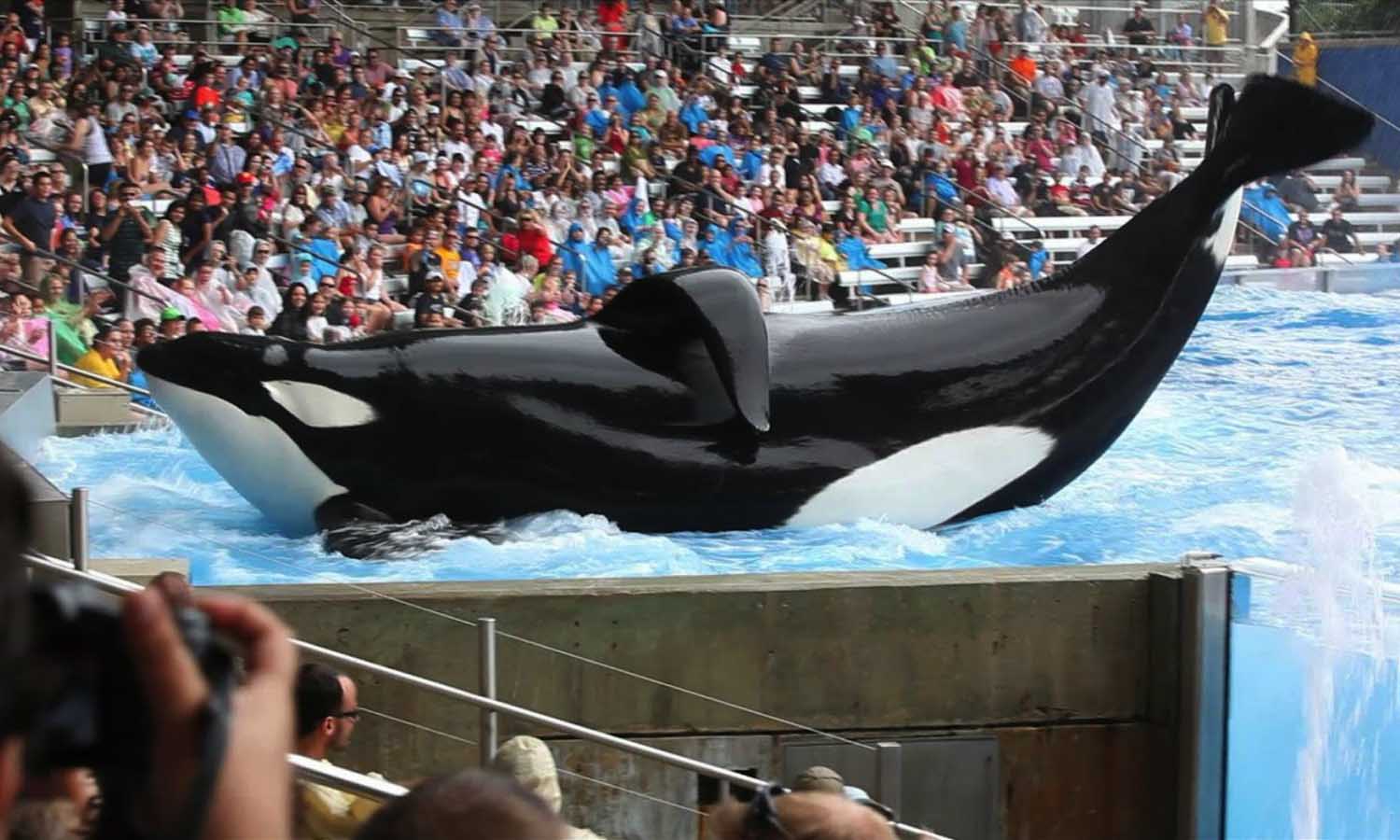
SeaWorld’s problem is that its biggest asset and biggest liability are the same thing — whales.

It needs to evolve and expand.

See, one of the main reasons that Disney and Universal continue to thrive is that they continue to evolve.

Ten years ago, Universal was all about superheroes and roller coasters. Today, it is Harry Potter and high-tech simulators.

Disney has grown and adapted as well. It started with fairy tales and an iconic castle. But Disney then reached out to older adults with Epcot, movie lovers with MGM Studios and animal lovers with Animal Kingdom.

Today — four decades after Disney’s first Orlando park opened — Disney is preparing to cash in on the worldwide phenomenon of a movie that didn’t even exist until last year: “Frozen.”

Meanwhile, SeaWorld’s main theme and attraction is the same as it was when the park opened 41 years ago: killer whales.

And the park is doubling down on that. It’s biggest spending plans involve hundreds of millions of dollars to expand and improve the whale habitats.

Other than that, the park has second-tier additions on the horizons — like a revamped Clyde and Seamore sea lion show, which the company described last week as “a hilarious tale, filled with amazing animal behaviors and splashy audience fun.”

Think about that. Universal has a new Harry Potter attraction that’s garnering worldwide attention. SeaWorld has a paid blogger, a bigger whale pool and a revamped sea lion show.

If Disney needs more than Mickey, SeaWorld has to understand that it needs more than Shamu.

Read the whole thing, and see who you think makes more sense: Atchison in Businessweek? Or Maxwell?

Can SeaWorld Be Saved?

Last week, Karl Taro Greenfeld managed an unusual feat: he was allowed inside SeaWorld’s corporate offices to interview SeaWorld’s leadership and report a Businessweek story called “Saving SeaWorld,” about SeaWorld’s efforts to survive and bounce back from the surprisingly powerful and accelerating #BlackfishEffect (seriously, I think it is fair to say that no one involved with the production fully anticipated the impact that resulted).

Since this is the first real access SeaWorld has given a big-time news organization since Blackfish started cratering SeaWorld’s image, its corporate relationships, and its stock price, it is worth taking a close look at what Greenfeld reported.

First up, Greenfeld gets SeaWorld CEO Jim Atchison to comment on SeaWorld’s PR strategy:

“There is no recipe to follow. There’s very little intuitive about it,” says Atchison. “Do I wish we would have taken a more aggressive action earlier? On an emotional level I do, because I was offended by it personally. … One of the things we had to measure early on was, how do we engage in it? We don’t want to aid the marketing of the film by engaging too openly, too aggressively, too early. We didn’t want to turn it into the film SeaWorld doesn’t want you to see. And the film didn’t really gain any kind of notable momentum until CNN started airing it. Repeatedly.”

I have to admit that I am sympathetic to SeaWorld on this point. SeaWorld had a long history of keeping its head down when bad things happen at its parks, and the bad news always blew away over time and allowed SeaWorld to get back to business. It is completely understandable that SeaWorld did not want to make a big deal out of Blackfish before Blackfish was, indeed, a big deal. Why help the public take notice of a film that will harm your business?

And Atchison is correct, I think, that the CNN airings are what blew Blackfish up into a public phenomenon (an important lesson to all film-makers who want their work to have impact). Following Sundance, and through the film’s theatrical run, there was just not that much public awareness about Blackfish. I have never been in the loop on the theatrical numbers, but I don’t think Blackfish was packing the movie houses. It wasn’t until Blackfish hit cable television, on CNN in late October (along with a pretty good CNN-designed social media plan) that lots and lots of people saw Blackfish and started telling others about it.

Continue reading “Can SeaWorld Be Saved?”

Better PR Will Not Solve SeaWorld’s Problems

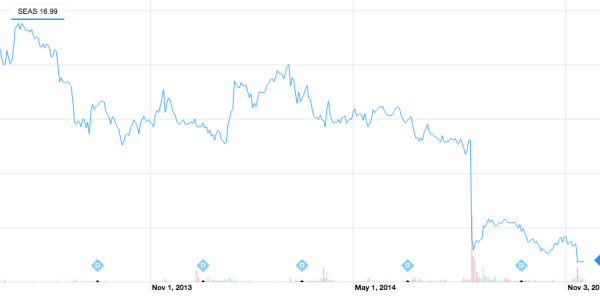
Screen Shot 2014-11-18 at 9.51.39 AM

SeaWorld already doubled down on its killer whale captivity model by pledging to invest tens of millions of dollars in bigger tanks. And now it is doubling down on the idea that better PR can defuse growing doubts about using killer whales for entertainment:

SeaWorld is working aggressively on improving its image as it continues to fend off criticism over its whales in captivity.

The company is disputing animal-rights activists online, soliciting fan support and trying to call more attention to its work with animals — such as rescuing underweight orphan manatees.

SeaWorld is making these efforts amid declining attendance and lingering controversy intensified by last year’s anti-captivity “Blackfish” documentary. The company said in an earnings report last week that negative publicity contributed to an overall third-quarter attendance decline.

“I think we’ve just realized we have to do a better job of telling our story, sharing the good work we do,” company spokeswoman Aimee Jeansonne Becka said, reiterating the thoughts expressed by Chief Executive Officer Jim Atchison earlier this year.

“You’re going to see a PR offensive coming here,” Wells Fargo analyst Tim Conder told CNBC last week. “You’re going to see SeaWorld being more open about who they are, educating people [about] who they are, with other organizations.”

Best of luck. Sometimes the apparent problem is an actual problem, and not just a failure to “tell your story.” SeaWorld, in fact, has done a brilliant job over the past 50 years of telling exactly the story it wants to tell. That’s why many viewers found the story told in Blackfish–which was VERY different–so shocking.

Changing the story to emphasize conservation (especially if it is backed up by real investments in conservation, which would be a nice) might help at the margins. But promoting conservation still does not address the fundamental reality that increasing numbers of people find killer whale circus shows anachronistic and cruel. The only way to address that problem is to change the business model and start transitioning away from the product that fewer and fewer people want to buy.

Despite the brutal beating SeaWorld is taking in the markets, and the steady decline in paying customers, it doesn’t look like SeaWorld is quite there yet.

SeaWorld Keeps Tanking

“C’mon SeaWorld. I’m sick to death of this routine, and so is the public.”

The latest earnings report is in, and attendance (and profits and revenues) keep dropping:

Shares of SeaWorld Entertainment Inc. (SEAS) are falling by 6.72% to $17.35 in pre-market trading on Wednesday, as lower attendance at the company’s theme parks hurts earnings for the second quarter in a row.

SeaWorld’s net income for the 2014 third quarter declined to $87.2 million, or $1 per diluted share, compared to $120.7 million, or $1.34 per diluted share for the same period in 2013.

The marine mammal entertainment company reported adjusted net income for the 2014 third quarter of $88.6 million, or $1.01 per diluted share, which fell below the expectations of analysts polled by Bloomberg of $1.13 per share.

Revenue for the most recent quarter fell to $495.8 million versus $538.4 million for the 2013 third quarter. Analysts expected $496.4 million in revenue for the quarter.

SeaWorld reported attendance of 8.4 million guests versus 8.9 million from the same quarter last year.

Trying to explain the continued drop in attendance, SeaWorld continues to avoid the elephant, I mean blackfish, in the room: The company believes the decline in attendance was due to negative media attention resulting from a proposed bill in California that would ban the use of orcas in shows, and a “challenging competitive environment, particularly in Florida.”

Yes, the Blackfish bill is an issue, but the media attention on SeaWorld is focused much less on AB2140 than it is on the very essence of SeaWorld’s business: its reliance on keeping killer whales captive for entertainment.

A few more earnings reports like this one and SeaWorld suits will finally have to confront the fact that their business model is being rejected by the American public. That means SeaWorld needs a new business model that doesn’t rely on killer whale captivity (or at least moves killer whale captivity offshore to China, Russia and the Middle East).

It seems likely that SeaWorld is pursuing the latter strategy of developing its franchise in nations that don’t (yet) care as much about the ethics of killer whale captivity. But powerful ideas (like the idea that it’s not right to confine killer whales for profit) have a way of working their way around the globe. And if SeaWorld simply tries to move its failing business model to new countries, instead of reinventing its business model, it could find itself repeating the history it is experiencing here in the United States, and continuing to struggle.

What SeaWorld really needs is not new spin, but new leadership that is not so invested in the idea of killer whale captivity, and can move beyond that business model and SeaWorld’s history to think clearly and creatively about what will attract and entertain the crowds of the future.

Adult-less Activism: Kids Vs. Captivity

Here’s another one. Must be the theme of the day.

Animated Activism: Killer Whale Captivity For Children

Animator Joey Cheers (with Fishy Thom and Teon Simmons) concocts a beguiling video to speak to young minds. (h/t Marineland In Depth)

A San Diego Progressive Takes On SeaWorld

Is this the best use of valuable San Diego property?

Not everyone who lives in San Diego thinks San Diego needs to protect SeaWorld. Linda Perine, of the Democratic Womans Club, wades into the fray with facts, links, and a fierce attitude:

Being very well connected and making a lot of contributions to politicians allows a business a fair amount of leeway, especially in San Diego.

As Voice of San Diego pointed out in one of its somewhat boosterish articles Sea World By the Numbers  Sea World employs up to 4,500 people, albeit many are temporary positions and minimum wage.

As was mentioned before, Sea World pays a percentage of its income as rent on a lease to the City that some view as extraordinarily favorable to Sea World.  While putting $14 million into the public coffers may be an attention getter, it is nowhere near what it ought to be.

Sea World is deeply imbedded in the San Diego conservative hierarchy.  It is a heavy contributor to the PACs of the Lincoln Club,the California Restaurant Association’s local chapter and the San Diego Regional Chamber of Commerce.   Sea World has a presence on the board of many local organizations like San Diego County Taxpayers Association, Equinox, San Diego Tourism Authority, the Chamber and many others.

Yes, that is the same Lincoln Club, Taxpayers Association, Chamber and Mayor who oppose increasing the minimum wage so that the workers at Sea World can afford to feed their kids.  So, no, they are not going to get all misty eyed over some “black fish”.

In the interconnected world of Who Runs San Diego it is the mutual back scratching benefit of interlocking boards and contributions to politicians that allows our Mayor and City Council to be so unquestioning in their support of this morally and fiscally compromised corporation.

Sea World is imbedded. It’s a player.  As its Prez said – they make no apologies.  And we are to be grateful?

If you like the attitude, read the rest of Perine’s takedown. There is plenty more.

SeaWorld’s (Slippery) Support Of The Virgin Pledge

SeaWorld has released a statement supporting the Virgin Pledge:

SeaWorld welcomed the opportunity to participate, along with similarly accredited organizations, in the six-month stakeholder engagement process on marine mammals conducted by Virgin Unite. We have always been willing to lend our expertise to any objective and science-based process that seeks to assure the health and welfare of animals living in professionally operated zoological institutions.

SeaWorld has supported efforts to protect and conserve our oceans for future generations since we first opened our gates 50 years ago. We were pleased to share this commitment with Virgin Holidays, and fully support their pledge concerning the collection of whales and dolphins from the wild — something SeaWorld hasn’t done in decades. The millions of guests who come through our gates each year are not only inspired and educated by what our parks offer, but also are key contributors to the important conservation and research we do that helps protect wildlife and wild places. We thank Virgin for recognizing the vital role zoological facilities can play in ocean preservation and conservation and look forward to working with them on these efforts in the future.

I highlighted the section about wild captures because it makes two questions pop into my head:

1) How does this statement lauding SeaWorld’s restraint regarding wild captures square with the fact that SeaWorld was part of a consortium led by Georgia Aquarium that in the past few years both captured 18 wild belugas and tried to import them into the United States?

The import permit was denied (Georgia Aquarium is appealing), which I suppose allows SeaWorld to stay technically consistent with the Virgin Pledge. Though to the extent that SeaWorld was part of the consortium that captured the belugas (even if Georgia Aquarium was acting as the umbrella for the group) I don’t think they can honestly say they haven’t “collected” from the wild in decades.

2) If protecting and conserving our oceans is linked to refraining from wild dolphin and whale captures, why stop with those species? Why not help protect and conserve our oceans by refraining from all wild captures?

Both those questions posed, I do credit SeaWorld for taking the Virgin Pledge. I also think it will have positive implications going forward, implications that SeaWorld may or may not have thought through. Having signed the pledge, plenty of people (like me) will keep an eye on the extent to which SeaWorld remains true to the spirit and letter of the pledge. And that could constrain how they pursue their marine mammal entertainment business.

For example, what if Georgia Aquarium wins its appeal regarding the wild beluga import? Will SeaWorld take its allotment of 11 belugas, and say “oh well, never mind” with regard to the Virgin Pledge? Or will it make a painfully self-interested argument that the beluga import is about conserving a wild species (even though belugas are not listed as endangered by the IUCN)? Or will it say “Hey, those belugas were caught before February 2014, so stop hassling us?”

No matter what option it chose, SeaWorld’s choice would come under extra-detailed scrutiny because it has signed the Virgin Pledge. Is it even conceivable that SeaWorld would take a look at how bringing in 11 wild belugas would look in light of changing public opinion about captivity and their support of the  Virgin Pledge, and take a pass on the wild belugas? Unlikely, I know. But these days it seems like almost anything is possible.

I can also forsee other choices SeaWorld might have to make in the future that will get extra scrutiny, and may even be constrained, thanks to SeaWorld’s commitment to the Virgin Pledge (even if the action comports with a very lawyerly, narrow reading of the words of the pledge).What about engaging in breeding loans with captive facilities that violate the Virgin Pledge? Or keeping future rescue animals for SeaWorld shows? Or breeding wild caught rescue animals, like Morgan, to increase SeaWorld’s killer whale holdings and benefit its bottom line?

That sort of analysis against the Virgin Pledge will be a very good thing. And while enthusiastically signing onto the Virgin Pledge today might yield a quick PR bump, I wonder if SeaWorld may come to regret taking the pledge down the road.

The Virgin Pledge** (**Including Loopholes And Caveats)

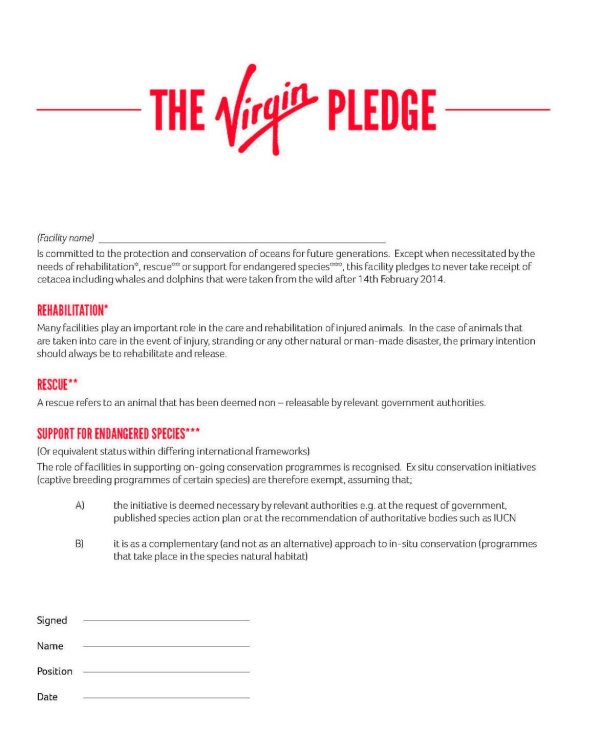
After months of deliberation, Sir Richard Branson has finally settled on the language of the pledge he wants captive facilities to make if they would like to continue to do business with Virgin companies. Here is how the Virgin Pledge reads:

THE_VIRGIN_PLEDGE_crop_sept_2014-1

While Branson and Virgin should get credit for at least engaging on this issue, and while this pledge would mean that a marine park can’t just buy a Taiji dolphin and continue to do business with Virgin, that’s about all it achieves. If you caught lots of wild dolphins for your shows before February 2014, no problem. If you engage in breeding loans with marine parks that capture wild dolphins and killer whales, no problem as long as the animal you are importing wasn’t wild caught (though it can be the offspring of a wild dolphin or whale, allowing your breeding program to benefit from wild captures). So the limitations it places on marine parks are quite narrow. Perhaps that’s why many, including SeaWorld, have already signed the pledge.

More problematic is the fact that the pledge is riddled with potential loopholes, for “rehabilitation,” “rescue,” and (this one could eventually be massive) “support for endangered species.”

The pledge says that rehab of injured or stranded wild dolphins or whales is okay, as long as you go to the trouble of at least pretending that you intend to try and follow rehab with release. But if you don’t happen to follow through, then feel free to go ahead and use the rehabbed animal in your shows and in your breeding program. Sorry, Morgan.

Rescue is similar. If a government authority deems your rescued dolphin or killer whale non-releasable, you are good to go. Shows, breeding, whatever.

What is not clear is whether a “rehabilitation” animal needs a government agency to say the animal can’t be released (making the animal a “rescue” animal?) in order for a facility to keep the animal. Or whether the simple declared intention to rehab and release is enough for Virgin to continue doing business with you if you decide circumstances have changed and you can’t release your rehabbed dolphin or whale. If the latter, then the “rescue” provision pretty much does nothing.

In some ways, that distinction doesn’t really matter. If Sir Richard and Virgin had dug deep enough into the issue of rehab and rescue they would have discovered that it is without question a backdoor into captivity for at least a proportion of wild animals, often with the willing assent of government authorities who for decades have sided with the marine parks over conservation groups when it comes to deciding whether an animal is releasable or not.

The last exception, “Support For Endangered Species” sounds like it could develop into a significant loophole, though we’ll have to see how Virgin chooses to interpret its language. These days, many wild captures or import permit requests claim that bringing a wild animal into captivity will help conserve it in the wild. However, most dolphin species (including most killer whale populations), and many whale species are not listed as endangered.

So what will this exception mean in practice? If the Georgia Aquarium succeeds in reversing the National Marine Fisheries Service denial of its request to import 18 wild-caught belugas, would Virgin stop doing business with Georgia Aquarium? Georgia Aquarium, notably, has not yet signed Virgin’s pledge. But SeaWorld has. Would SeaWorld be able to “borrow” some of Georgia Aquarium’s wild-caught belugas and claim this exemption by arguing it will be helping conserve wild beluga populations? If it could then the exemption will open up a pretty big door into captivity for wild-caught animals, especially as wild populations continue to come under pressure from pollution, noise and climate change.

Here’s the bottom line. Virgin says that “our core objective was to eliminate demand for whales and dolphins from the wild.” I think a fair reading of the pledge is that it could reduce demand for wild captures (and how great that reduction is will depend on how Virgin interprets the actions of marine parks according to the Pledge), but it will certainly not eliminate demand.

For all these reasons, whale and dolphin groups have issued a statement in response to the Virgin Pledge, correctly noting its limitations. Smartly, they call on Virgin to continue refining its pledge to reflect evolving public opinion on the issue of marine mammal captivity:

Although the pledge is a step in the right direction, we expected more from the Virgin stakeholder process, and we are calling on Virgin to return to the table to discuss  key future actions including a commitment to (1) work with suppliers to end shows and captive breeding programs within a specified timeframe , (2) prohibit breeding or display as part of rescue or rehabilitation programs, and (3) help develop sanctuaries or other alternative display environments that ultimately improve the quality of life for captives that may never be returned to the wild.

This is exactly the right response, and since this controversy over captivity will not go away simply because Virgin has issued its first take on the pledge, I think that the dialogue between Virgin and all stakeholders will continue to evolve over the coming years. Of course, that does not do much good for the dolphins and whales currently in captivity. But I think the Virgin Pledge reflects an important acknowledgement that there are ethical issues with regard to the current captivity model, and that changing public opinion means that the captive industry is not always a good industry to be doing business with (as Southwest and others have also concluded).  And as public opinion and awareness of the ethical issues raised by marine mammal captivity continue to build, businesses like Virgin will continue to challenge the captive industry to evolve and change for the better.

[Personal nit-pick on the Virgin Pledge: Sir Richard, in his introduction of the Virgin Pledge, says that the announcement he made in February, which set all this in motion, was that Virgin businesses would only do business with suppliers who pledge not to take “sea mammals” from the wild. Yet the pledge only applies to cetacea (dolphins and whales). So as far as Virgin is concerned it is still a free-for-all when it comes to capturing wild sea lions, walruses, and other pinnipeds for the shows. Somehow they got dropped from the pledge, and since that is the case Virgin should stop referring to the “Virgin Pledge On Sea Mammals.”  It should correctly be called be the “Virgin Pledge On Some Sea Mammals (But Not All Of Them Because People Care More About Dolphins And Whales)”].

Animal Care Angst

AC HortonNursing

Over the past month I’ve been digging into the lives of former SeaWorld Animal Care workers, and publishing their stories (here, here, and here). Many of their experiences seem shocking to people unfamiliar with animal care work, and how difficult it can be. And it is easy to see how the stories can fuel an anti-SeaWorld sentiment.

Jim Horton, one of the three former Animal Care workers I interviewed, was troubled by the vehemence and hardcore anti-SeaWorld nature of some of the comments he saw posted to social media in the aftermath of the stories (big mistake, to read comments, I explained). And also by the fact that many of the stories published in the Animal Care series focus on the negative aspects of the lives of the workers and the nature of managing animals in captivity.

Animal Care obviously includes a lot of positive experiences, where animals are nurtured, rescued, or saved. And the thing I admire most about the Animal Care workers I spoke with and wrote about is that they did the work–with all the good, the bad and the ugly–because they cared first and foremost about the animals. They weren’t there to become Shamu Stadium stars. They were there because they loved animals and wanted to care for them. Eventually, especially for Krissy Dodge and Cynthia Payne, the nature of the work, and the way in which captivity compromised the lives of the animals, forced them to step away and pursue other careers. But the point is that Animal Care work, and the emotions and realities involved, is not at all simple. How Animal Care workers feel about the work they do, especially post-Blackfish, is an intensely complex subject, and that didn’t always come across in the articles I published.

So in order to dig deeper into what Jim Horton felt and feels about the work he did, and how Blackfish opened up many difficult questions, I am posting (with Jim’s permission) a letter that he wrote to a friend. In it, Jim explores and articulates the powerful and conflicting emotions he feels about the work. And if you want to judge him or Animal Care workers harshly, as so many were quick to do, I only ask that you make sure you read this letter first:

Dear ……,

I feel your pain. I think the movie Blackfish and it’s flock of anti captivity followers has made us all take a deep look inside at what we have done over the years and where we are now emotionally in our careers as animal care takers. Torn between our love of the animals we have come to know and the public outcry from those that have never experienced what we have, with the exception of a few. I find it very ironic that the world of those we entertained and taught priceless educational values to are now claiming injustices and untruths that rock the very core of our souls, creating gaps and even bitterness between our friends, co workers and family.

I’m sure you can recall as I can the hundreds of times we were told by the public, family and friends that we must have the greatest job in the world. I recall, later on in my career, often scoffing at that comment and explaining to those that would listen, that this career is a labor of love and full of extreme highs and extreme lows and at times can very well be the worst job in the world. Those people, the ones looking from the outside in, so-called experts by the very knowledge that we as teachers have taught them, through the media and personal interactions, have no idea what it was like and also what it is like now.

What they don’t know and what the media never found newsworthy is the extreme duress we’ve gone through. The news only covers the animal’s story, not ours. The nights on end of watching, medicating, note-taking of sick animals. Every 3 hour tube feedings, injections and enemas, standing alone in poop-filled pools in freezing temperatures to bottle feed baby manatees or baby dolphins, while those around us celebrate Thanksgiving and Christmas, forgetting their anti-captivity rhetoric, while we shiver through the night, tired and hungry in the middle of a 24-hour shift doing everything you can to save a creature who has put all of it’s trust into us. Knowing fare well that if you screw up, fall asleep standing up, or miss a subtle cue of distress that this beautiful creature may die. They have not experienced the pain of watching and the feeling of the last heartbeat and breath of a dolphin, sea lion, or manatee dying in your arms, looking you straight in the eye as if to say help me or thank you, and in those final moments only you can decipher the final thoughts before death. You begin to cry if you’re alone there in the dark and cowboy up if you’re surrounded by peers, only to let it out in the seat of your car in your employers parking lot at the end of a very long day. You sit and ponder in anguish at what you could have done differently to save this one and what you can do the next time. You celebrate their life by helping the next one of their species.

Unless you’ve done it, one could never understand what it’s like to cut open and remove the brains and eyes of an animal you’ve cared for all it’s life. Sure, you put on your scientist mask, bundle up all of your emotions and swallow them like a big nasty pill and commence to do your job in the efforts of science and discovery and the personal need to know why. Your internal emotions and feelings of sadness, images of the happier times with this animal run through your veins in the form of liquid courage and it takes all of your might to carry on stoically. Hoping to find that smoking gun, that reason for not surviving your treatment. You hope to see the worst, a cancer, an infected kidney, inoperable stomach blockage or a brain abnormality. Often we find nothing and spend the rest of the evening wondering what went wrong and what could you have done differently. The thoughts haunt you through the night as your friends and family wonder why you’re so despondent and can’t sleep or why you aren’t in the mood to eat that piece of steak. Our reward is to move on to the next case unless you are one of the unfortunate ones that has to make that trip the following day to the rendering factory to dispose of the carcass and once again, feel those emotions as you toss a head that you’ve hugged a thousand times into a vat of guts while dodging the spray of nastiness.

They will never know the pain of the animal bites, the broken bones, contusions, sprains, cortisone injections, IV fluids, stitches, ear infections and the unfortunate times you had vomit, the diarrhea and the long dead animal guts and maggots fly into your eyes and mouth.

They will never know the disappointment and the emptiness you cast upon your families with missed vacations and birthdays and the wonderment by those you love that can’t understand why you lack emotion at the death of a family pet or when you make an early decision to put the animal to sleep, knowing early on the inevitable suffering that prolonging death can create.

They will never know what that final rub down, that saying of I’m sorry, what that pat on the back of an animal feels like when you are getting ready to inject a life ending medication in an upwelling of humbleness and hopelessness, a surrender of effort of all your skills to prevent suffering.

They will never know the terror and horror, the sounds and images of being in a rescue van or cage or pool when an animal goes through its death throes. Flailing about in a final fit of uncontrollable rage, sending humans, skin and blood flying through the air, destroying everything in it’s path and then the sudden unexpected feeling of what was once hope comes crashing to the ground in a matter of seconds.

They will never know the many times we came very closed to being killed, mauled, drowned, or losing a limb, toe or finger or co worker in the efforts of just doing our job, you know, the one that is the greatest one in the world?

And so now were are forced to believe by many that this isn’t the greatest job in the world, that all that we’ve done, all of the pain and effort, tireless nights and trips to the hospital is a bad thing. They say our animals are treated poorly, our facilities are substandard, and we should be ashamed. Ironically, in a much misinformed manner, these foul cries of care seemed limited to the United States, where the best care in the world is provided. Having transported animals all over the world, I have truly seen the atrocities of animal care in third world countries. But that’s ok I guess, because we only believe what we see and fail to listen to the real experts. Untouchable they are the third world facilities, look at Taji. Those animals are captured and slaughtered every year, yet there are more outcries regarding a little blonde haired girl blowing a whistle–feeding and rubbing down an animal that she truly loves and will give her all with great sacrifice to her life and those around her in an effort to give that animal a good life- than the cries of slaughter. The paths we chose in the animal industry we didn’t always chase. We started as education staff, operations staff, cigarette butt picker up’ers, scuba divers and bucket washers. Suddenly, we were given the opportunity to be closer than most to these wonderful creatures. I’m sure there isn’t a soul in the business who hasn’t stated that “I can’t believe I’m getting paid for this”. So innocent and inexperienced, having no idea that this journey will take you through a river of emotions, good and bad and that those children that you teach and share the joy of making a connection to animals, those children will grow up to say what you are doing, the efforts that you made, were not in the animals’ best interest.

I can truly say that I am against captivity and I am for captivity. I think perhaps, maybe it’s time to end Killer Whales in Captivity, but why not the elephants? I don’t really see the need anymore, we’ve learned about all we can. On the other hand, if it were not for having killer whales in captivity, who would have freed Willy? Who would have rescued, rehabilitated and released Springer? Who would have flown to Turkey for 2 years of their life to train captive dolphins to be wild again and set them free? Who of you out there are planning and watching every day the case of Morgan the Killer whale in Spain. Who of you is experienced and ready to leave your family for years to train and release this little whale back to her family? Who is prepared to make real sacrifices other than spouting verbal diarrhea from your warm cozy couch with an I Pad……..We are!

We are the ones who still love our job, we love animals in our care more than our friends and our future. We are proud of our accomplishments, we do make a difference in the lives of others, we are tough as nails, we are not afraid, we can control our emotions, we can laugh in the face of adversity and we can succeed where others have never tried. We teach and train the animal caretakers of the future, there will always be a need for us. Who is going to save the beached animals of the future? Movie directors?

I am proud of who I am and those that I have helped have a better life. I am not part of the problem, I am the solution. I am an animal husbandry specialist and I will never stop caring.

There you have the conflicts, the pathos, and the doubts (and certainty) of animal care, all wrapped up into one deeply felt letter. I don’t criticize Animal Care workers. In my view they are doing their best, for the right reasons, in a captive entertainment model that is flawed and that I think needs to be reinvented. I reserve my skepticism and criticism for that model, not for the people who do their best to ease the lives of the animals trapped in that model. It is easy to say they shouldn’t do that work. But if they didn’t do you think the lives of the animals would be better or worse? I thought so.