Why Do Marine Animals Eat So Much Plastic?

It doesn’t just look like food. It smells like it too. Via NatGeo:

Algae are consumed by krill, a small crustacean that is the primary food source for many sea birds. As algae breaks down naturally in the ocean, they emit a stinky sulfur odor known as dimethyl sulfide (DMS). Sea birds in the hunt for krill have learned that the sulfur odor will lead them to their feeding grounds.

It turns out that floating plastic debris provides the perfect platform on which algae thrives. As the algae breaks down, emitting the DMS odor, sea birds, following their noses in search of krill, are led into an “olfactory trap,” according to a new study published November 9 in Science Advances. Instead of feeding on krill, they feed on plastic.

So humanity’s plastic debris is the perfect poison once it is in the ocean. Recycle, recycle, recycle. or don’t buy it in the first place (the ideal solution but I have tried avoiding plastic and it is NOT easy).

This is from Chris Jordan’s powerful campaign (which also produced the picture above) to help protect albatrosses from plastic debris:

The Limits On Trump’s Ability To Trash The Environment

“Ahh, now that Trump and Ebell are in charge we can finally breathe a little.”

Andrew Revkin notes hopefully that there are (some) limits on how much damage President Trump can do to the planet:

The bad news about climate change is, in a way, the good news:

The main forces determining emission levels of heat-trapping carbon dioxide will be just as much out of President Trump’s hands as they were out of President Obama’s. The decline in the United States has mainly been due to market forces shifting electricity generation from coal to abundant and cheaper natural gas, along with environmental regulations built around the traditional basket of pollutants that even conservatives agreed were worth restricting. (Efficiency and gas-mileage standards and other factors help, too, of course.)

At the same time, the unrelenting rise in greenhouse-gas emissions in developing countries is propelled by an unbending reality identified way back in 2005 by British Prime Minister Tony Blair, when he said, “The blunt truth about the politics of climate change is that no country will want to sacrifice its economy in order to meet this challenge.”

At the same time, as well, other fundamental forces will continue to drive polluted China and smog-choked India to move away from unfettered coal combustion as a path to progress. An expanding middle class is already demanding cleaner air and sustainable transportation choices — just as similar forces enabled pollution cleanups in the United States in the last century.

But Revkin’s analysis is relative to a baseline that is already taking us toward disaster. Under President Trump we will just get there a little faster instead of a lot faster.

He goes on to discuss the environmental movement and whether it should go all out with demonstrations and civil disobedience to keep oil in the ground and prevent pipelines from being built. I am entirely sympathetic with the emotions behind mass action, but I think President Trump and the Republican Congress will enjoy throwing lots of greens into jail. Instead, I wish the environmental movement would adapt a strategy of humble and sincere personal responsibility and action. That is something others can get behind, regardless of their political leanings.

Finally, Revkin notes that the Supreme Court has ruled that carbon emissions are classified as a pollutant under the Clean Air Act, which mandates that a Trump government limit them (or be subject to lawsuits). That is somewhat soothing, but very much underestimates what a Trump Supreme Court will do with environmental law and corporate regulations, especially if Trump gets another appointment–for Breyer or Ginsburg, say–beyond filling the seat Obama should have been allowed to fill.

Also, it is said Trump is leaning toward this guy for administrator of the EPA. That tells you all you need to know about how hard he will work to evade all the limits Revkin finds hopeful.

So don’t get distracted by all the back and forth about how terrible (or not) President Trump will be. It doesn’t really matter. Instead, I take hope from continuing to try to live in a way that values and conserves the natural world and all the nonhuman species out there who are struggling with our presence. In my fantasy world enough people do that to form a new political movement that can flourish amid the rubble of the failing two-party circus. No one in government, not even Myron Ebell or President Trump, can prevent that.

Trump Vs The Planet

“Alright, let’s fire these babies up!”

Brad Plumer of Vox lays out the implications of a Trump Presidency (and Republican control of Congress) for the environment:

And there’s no way around it: What he’s planning to do looks like an absolute disaster for the planet (and the people on it). Specifically, all the fragile but important progress the world has made on global warming over the past eight years is now in danger of being blown to hell.

Trump has been crystal clear about his environmental plans. Much of the media never wanted to bring it up, never wanted to ask about it in debates, never wanted to turn their addled attention away from Hillary Clinton’s email servers to discuss what a Trump presidency might mean for climate change. But all the indications were there:

  • Trump called global warming a Chinese hoax. He couldn’t have been blunter about this.

  • Trump has said, straight up, he wants to scrap all the major regulations that President Obama painstakingly put in place to reduce US carbon dioxide emissions, including the Clean Power Plan. With Republicans now controlling Congress, he can easily do this. Pass a bill preventing the Environmental Protection Agency from regulating CO2. Done.

  • Trump has also hinted he wants to get rid of the EPA entirely. “What they do is a disgrace,” he has said. If Congress agrees, he could readily scrap other regulations on mercury pollution, on smog, on coal ash, and more.

  • Trump has said he wants to repeal all federal spending on clean energy, including R&D for wind, solar, nuclear power, and electric vehicles. Again, with Congress at his side, this is totally doable.

  • Trump has said he wants to pull the United States out of the Paris climate deal. There’s nothing stopping him. (Technically, the US can’t officially withdraw for four years, but for all practical purposes, the Trump administration could ignore it.)

All true. And some experts calculate that the impact on climate of Trump will be an additional 3.4 billion tons of carbon emitted.

But it should also be noted that the trajectory of the blue dotted line representing carbon emissions under a President Clinton also leads to climate disaster. Incremental progress will be reversed by Trump. But as I noted earlier incremental progress is not enough.

Key point: nothing that President Trump does or says will compel you or me to emit more carbon. Keep working to change how you think and live. Keep working to change how the people around you think and live. Live the argument. Win the argument. And then win an election that brings about real and meaningful change.

Food And Sustainability In 11 Charts

Or, “How To Ruin Thanksgiving But Save The Planet.”

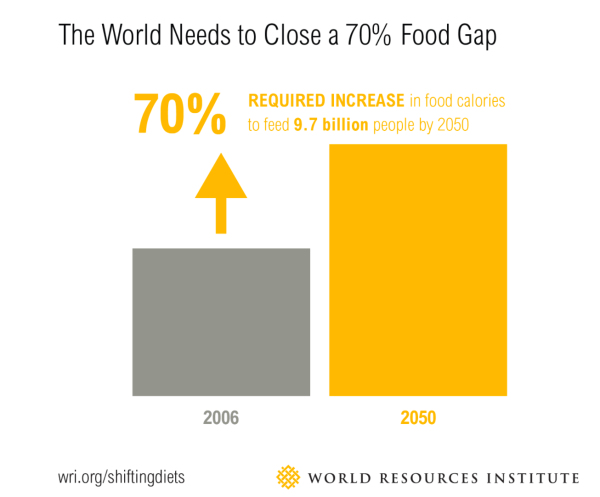
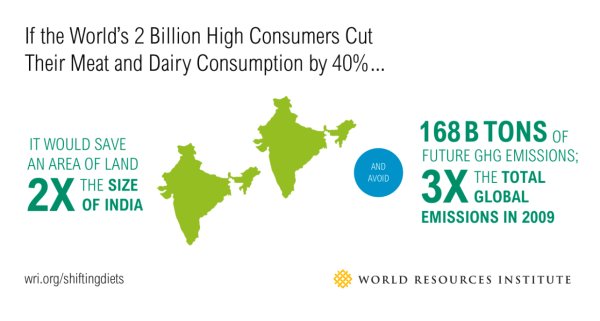
There is no human activity which affects the planet more than what we eat and how we produce it. I’ve long argued that the single biggest thing any individual can do to reduce his or her impact on climate change, land use, water quality, soil loss, and biodiversity is to change what’s on the plate. Fewer calories, less protein, much less or (even better) no meat and animal products, and organic. That’s the simple formula for radically reducing the human footprint and giving the natural world a chance.

Here, courtesy of the World Resources Institute, is a visual explanation of that argument. Print it out and take it to Thanksgiving dinner!

screen-shot-2016-11-04-at-9-03-19-am

screen-shot-2016-11-04-at-9-11-12-am

screen-shot-2016-11-04-at-9-12-10-am

screen-shot-2016-11-04-at-9-17-11-am

screen-shot-2016-11-04-at-9-18-20-am

screen-shot-2016-11-04-at-9-19-13-am

screen-shot-2016-11-04-at-9-19-59-am

screen-shot-2016-11-04-at-9-20-35-am

screen-shot-2016-11-04-at-9-21-17-am

screen-shot-2016-11-04-at-9-22-04-am

screen-shot-2016-11-04-at-9-23-06-am

screen-shot-2016-11-04-at-9-23-39-am


Dams Are Damning Southern Resident Killer Whales

J28 with “peanut-head” and J54 malnourished Photo by Ken Balcomb, October 2, 2016

The native peoples of the Pacific Northwest understood something important about the relationship between the region’s iconic killer whales and the region’s iconic salmon. The first could not survive without the second. “No fish, no Blackfish” they observed.

That observation is in danger of proving prophetic. As the Center For Whale Research’s Ken Balcomb warns, lack of prey food is threatening the demise of the endangered Southern Resident Killer Whales. The SRKW population is under pressure for a number of reasons–shipping, noise, habitat loss and pollution, among them. But Balcomb is warning that the most clear and present danger is hunger resulting from declines in the Pacific Northwest’s great salmon runs, mainly due to the damming of rivers. Currently, Balcomb and others are calling for breaching four dams on the lower Snake River which have devastated the region’s once-prolific Chinook salmon runs. And for compelling evidence of what is happening he points to the recent deaths of a mother killer whale and her calf, both of whom were evidently malnourished.

For the data-inclined, here is a chart that looks at the correlation of SRKW mortality and Chinook abundance.

The tension between dams and killer whales is just one more reminder of how closely connected different ecosystems can be, and the endless consequences for the natural world of human development. Dams may provide “clean” hydropower, but they do so at the unacceptable cost of destroying and damaging entire river systems and the species that rely on them. Wind and solar have impacts, too, but they are more local and limited.

Removing dams is one of the most promising environmental trends. And when you take dams down and allow rivers to flow freely again, remarkable things happen. Whether the Snake River dams will be breached in time to save Washington state’s killer whales involves an excruciating race against time and hunger. Even the courts are pushing hard on this issue. But Ken Balcomb, who has been studying this population for 40 years and knows more about these killer whales and what they need than anyone on the planet, is pretty clear that if dam breaching is going to happen it better happen very, very soon.

Sustainable Is Also Healthy

In my recent Outside story about sustainable eating I didn’t get into the question of whether foods which are easier on the planet are also healthy (or healthier). So this Washington Post story, which looks at whether there is scientific consensus or disagreement, on a number of dietary choices, caught my eye.

Check out this summary chart. Looks to me as if there is pretty solid scientific consensus on the health benefits of a more plant-based, low environmental footprint diet.

Screen Shot 2016-01-13 at 10.52.26 AM

It reinforces what I believe about plant-based foods. They are a three-fer: 1) Good for you; 2) Good for the planet; and 3) Good for animals.

I find that logic overwhelming, which leaves taste and habit as the only real barriers to a plant-based diet. And good recipes (and chefs like Dan Barber) can easily obliterate those barriers.

Diet And The Planet

1920px-ecologically_grown_vegetables

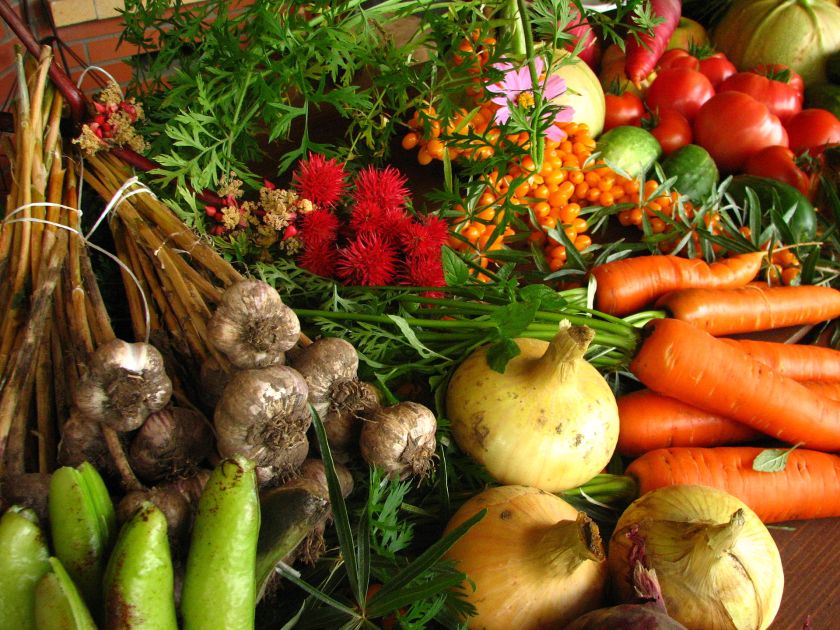
After writing about eating seafood more sustainably, my editor at Outside and I figured we might as well go Full Monty and broaden the question to take a hard look at eating more sustainably in general. So I dove into lots of research on how our food choices affect the planet, and you can read the results here.

Key takeaways:

  • your food choices are the easiest way for you to dramatically shrink your environmental footprint
  • eating less or no meat has the biggest impact on dietary sustainability
  • if you want to maximize both your nutrition and the environmental benefits of your diet, eat more pulses/legumes: lentils, beans, etc.
  • we worry way too much about whether we are getting enough protein. We get plenty, even if we are vegetarians, and eating more protein than we need is very costly to the environment
  • going vegetarian can halve your impact on climate, and land and water use; going vegan can reduce it by around three-quarters (I was impressed by the extra environmental bump you get from going from vegetarian to vegan).
  • eating organic has a demonstrable benefit to soils, waterways and climate.
  • one of the biggest environmental tragedies related to diet is food waste–which in the US is a shocking 40%. That also makes reducing food waste in your home a huge opportunity to shrink your environmental impact.

So, to sum up, if you really want to eat more sustainably: Eat less or no meat, and eat  organic and locally whenever possible. Stop eating so much protein, and stop eating so much in general (overeating is costly to the planet and your health). Oh, and stop wasting so much food!

Oceans Of Plastic

This stuff is ashore so it doesn’t even count.


Dr. Evil, who deals only in millions, would be shocked by this:

A major new study of the world’s oceans has reached a shocking conclusion: Thanks to humans, there are now over 5 trillion pieces of plastic, weighing more than 250,000 tons, floating in water around the world.

With a global population of about 7.2 billion, that’s nearly 700 pieces per person.

The study, published in the journal PLOS One by Marcus Eriksen of the Five Gyres Institute in Los Angeles and a large group of colleagues, is based on data from 24 separate ocean expeditions, conducted between 2007 and 2013, to sample plastic pollution. Plastic was either observed from boats, or hauled up from the ocean by nets, in 1,571 locations. The data were then used to run an ocean model to simulate the amount and distribution of plastic debris.

That’s a nearly incomprehensible amount of plastic. What’s worse, though, is that there is probably a lot more than that:

The authors stress that they suspect their estimate is “highly conservative” — there could be a lot more plastic out there than that. For as they note, there is also a “potentially massive amount of plastic present on shorelines, on the seabed, suspended in the water column, and within organisms.”

In particular, the authors cite a figure from the trade group Plastics Europe, which suggests that 288 million tons of plastic are produced annually. Compared to a figure like this, the 250,ooo tons described in this study represent “only 0.1 % of the world annual production” — again underscoring that the numbers reported in the study, large though they are, are probably a low end estimate.

The American Chemistry Council responded to the study by stressing the importance of recycling. Okay, hard to argue. But with these sorts of stories about humanity laying waste (literally) to the planet, I keep coming back to the same thing. Consumables need to be priced differently, to reflect their environmental impact and cost. Adopting that approach–which is the only thing that radically changes industry and consumer behavior–is really the only hope of limiting human impact on the planet.

In the meantime, I will put plastic alongside the internal combustion engine as a two-edged human invention that created wealth and progress while simultaneously destroying natural capital.

A Scientist Combats Climate Change (A Bit)

Eric Holthaus quit flying to reduce his carbon footprint:

This week marks one year since I last flew on an airplane. To the likely dismay of Fox News, which called me a “sniveling beta male,” my decision didn’t result in a dramatic tailspin of self-loathing or suicide, the ultimate carbon footprint reducer. Quite the contrary: It’s been an amazing year.

My decision was prompted by a science report that brought me to tears. It wasn’t that the consensus statement was particularly new or noteworthy—we all know by now that climate change is one of the biggest challenges we’ve ever faced as a civilization—but that, for the first time, I realized that my daily actions were powerful enough to make a meaningful change.

Folks, we are in trouble if a scientist just now realizes that his daily actions are powerful enough to impact climate change. And chooses to quit flying instead of digging deep enough to discover that if he really wants to make an impact he should also have quit meat.

He comes to many of the right conclusions:

What the math behind climate science is asking for is nothing less than a revolution. Anderson thinks scientists like him should lead by example. “I think we have to start to actually act accordingly with our own analysis. That lends credibility to our work.” This holds true for nonscientist advocates, too, he believes. “Al Gore’s probably got an emission footprint similar to a small African country, and he’s wandering about the planet telling other people that they should reduce their carbon emissions.”

Still, Anderson admits that it’s a big ask to broaden the efforts from a few passionate scientists to broader society. But without that, the chances of maintaining a stable climate are slim. Still, Anderson remains about as optimistic as his research permits him to be.

“I think we will fail, but I don’t know we will fail. There’s a very big difference between those two.” Anderson continued, “It’s likely we will die trying. But if we don’t try, then we will definitely not succeed. I work in this area because I still think there’s a thin thread of hope.”

Well, maybe less than a thread if a dude can write an article about how we need a revolution, how personal choices have an impact, notes what incredible climate hogs Americans tend to be, and somehow misses the most carbon intensive choice he makes every day that he reaches for a bacon burger.

We all need to make changes. And, sure, reducing air travel can make a difference (you should have seen my wife’s face when I told her I thought we should fly only once a year, and explore the area around DC instead of immediately hopping on planes whenever we wanted to go somewhere).

But the most important and impactful first step in this personal revolution, apparently missed by both these scientists, is simple: stop eating meat. (Do that, and you might even be able to fly a little!)

And if everyone did the same, and scientists who wrote articles about climate change followed the numbers wherever they went, then we might have a little more than a “thread of hope.”

Climate and Capitalism

Zachary Karabell offers an interesting critique of Naomi Klein’s This Changes Everything:

In fact, capitalism—in the form of multinational corporations—is doing more than many governments and multilateral institutions to stem the progression of climate change. They are doing so because of self-interest, not altruism; the relentless demand for profit is compelling an increasing percentage of the world’s largest companies to take concerted, forceful action. Yes, many companies remain obstacles to action, as Klein argues, but increasingly, more are becoming the agents of rapid and necessary change.

To say that corporations are doing more than governments to combat climate change is not to say much, since governments have proved so incapable of communicating the problem and rallying the public behind policies to address it.

But, sure, there are corporations that are looking to make profits from developing goods and technologies that will reduce carbon emissions. At the same time, there is no question that there is a multitude of corporations, even beyond the carbon energy sector, whose businesses hurt the climate and whose profits depend on fighting changes in their business practices. And Klein is very effective in explaining how that works.

But to me, the real issue is not the behavior of specific companies. It is the structure and nature of the form of capitalism that humanity has developed and celebrated. Klein is correct, I think, that the era of deregulation gave corporations more freedom to pursue business and profits that harm the environment and climate. But the underlying dynamic is a global form of capitalism that relentlessly pursues growth and sales, promotes consumption, and does not hold corporations fully accountable for the external costs to the environment of their business practices and products.

So this shouldn’t really be an argument over whether capitalism is good or bad. Instead it should be an argument about how to reform or reinvent capitalism so that the incentives in play for both businesses and consumers don’t destroy the planet.

The single most powerful reform I can think of would be to hold businesses and consumers accountable for the choices they make, by starting to adding to the sales price of most goods the costs to the environment and climate. That would mean a tax on carbon, and much more. Want to drive a Hummer? Sure, but you will pay extra. Want to eat burgers every day? Go for it, but boy will that get expensive.

Pricing is the key variable that, to paraphrase Klein, can change everything. If businesses had to pay for their impact on the planet they would change how they do business, and carbon-heavy industries would wither away while carbon-friendly industries would grow and thrive. If consumers had to pay for the way in which their consumption impacts the planet, they would change the what they consume and how much they consume.

Of course, getting governments to make this shift is the hard part. Part of the reason that corporations and governments haven’t done a better job of confronting climate change is that their publics don’t really want to make the changes, and fear that change means sacrifice. In this regard, Klein’s argument is vital. Governments and corporations will change when voters and consumers demand it.