A Chinese vessel that ran aground on a protected Philippine coral reef was found to contain more than 20,000 pounds of meat from the scaly anteater, a protected species prized for its supposed medicinal qualities.
A wide evening view to Måbødalen in Eidfjord municipality, Hordaland, Norway, in 2011 August. The view has been captured from the eastern end of the valley. Photograph by Simo Räsänen (User:Ximonic)
Florida’s endangered manatees, already reeling from an unexplained string of deaths in the state’s east coast rivers, have died in record numbers from a toxic red algae bloom that appears each year off the state’s west coast, state officials and wildlife experts say.
The tide has killed 241 of Florida’s roughly 5,000 manatees, according to the state Fish and Wildlife Research Institute, and the toll appears certain to rise.
The number of deaths from the tide far exceeds the previous annual record of 151. Most occurred along the lower west coast of Florida near Fort Myers, where an algae bloom that began last fall was especially severe and long-lasting.
Not that there was much doubt, but a scientific paper categorizes and defines the level of extreme cruelty. The DotEarth blog digs in:
In a new peer-reviewed study, scientists assess the killing method employed by the dolphin hunters of Taiji, Japan, by watching video recorded surreptitiously in 2011 by a German dolphin-protection group, AtlanticBlue. The still image at right is from the video, which can be seen here (but be forewarned; this is not suitable for children — or many adults, for that matter).
Here’s the researchers’ not-so-surprising prime conclusion:
This killing method does not conform to the recognized requirement for “immediate insensibility” [some background is here] and would not be tolerated or permitted in any regulated slaughterhouse process in the developed world.
Annually in Japanese waters, small cetaceans are killed in “drive hunts” with quotas set by the government of Japan. The Taiji Fishing Cooperative in Japan has published the details of a new killing method that involves cutting (transecting) the spinal cord and purports to reduce time to death. The method involves the repeated insertion of a metal rod followed by the plugging of the wound to prevent blood loss into the water. To date, a paucity of data exists regarding these methods utilized in the drive hunts. Our veterinary and behavioral analysis of video documentation of this method indicates that it does not immediately lead to death and that the time to death data provided in the description of the method, based on termination of breathing and movement, is not supported by the available video data. The method employed causes damage to the vertebral blood vessels and the vascular rete from insertion of the rod that will lead to significant hemorrhage, but this alone would not produce a rapid death in a large mammal of this type. The method induces paraplegia (paralysis of the body) and death through trauma and gradual blood loss. This killing method does not conform to the recognized requirement for “immediate insensibility” and would not be tolerated or permitted in any regulated slaughterhouse process in the developed world.
DotEarth also puts a few questions to co-author Diana Reiss, and includes a bunch of other useful links on the topics of Taiji, dolphins and intelligence.
Q. One of the standard replies from Japan on this issue (whether with whales or dolphins) is that we, for example, cherish bison but eat bison burgers. Is there a distinction?
A. You cannot compare bison to dolphins in the cognitive domain. However, bison are not killed in this inhumane manner. Nor are lab rats. In cases in which animals are domesticated for food, most modern countries are striving for better animal welfare practices that minimize pain and suffering during the killing process with the goal to render an animal unconscious quickly before it is killed. This is not the case in the dolphin drive hunts. These are not domesticated animals; they are wild dolphins that are captured within their social groups, mother and young, and slaughtered using a technique that actually prolongs death, pain and suffering. The herding procedures themselves are inhumane and may include forced submersion as the dolphins are dragged by their tails to shore to be killed.
This is not to say that dolphins should be killed. They should not.
This is probably the best answer Reiss could give to the contradiction of supporting animal rights and welfare for certain species, but eating meat produced by practices that are also cruel and inhumane. And I agree that the dolphin slaughter should be stopped quite apart from livestock slaughter.
But it is not really a satisfactory or convincing answer. There is a moral contradiction in eating meat while expressing outrage at the abuse and cruelty involved in the slaughter of other species. You can try to defend one species but not another by creating different categories of animals based on intelligence. But while cows and pigs might not be as intelligent as dolphins, they are sentient beings. They know fear. They know loss. To die is painful and they resist that fate as ardently as any species, no matter how intelligent. In the end, the only position which truly avoids this moral contradiction is to oppose animal slaughter and cruelty for all species.
So what kind of killing WOULD be acceptable? It is absolutely offensive that anyone who works in the dolphin captivity industry would feel they have anything worthwhile to say about the Taiji dolphin drives. This is not about dolphin welfare any more than murdering humans is. This is about dolphin rights. But those in the captivity industry will continue to milk the welfare issue because it provides them a way to appear to be concerned about Taiji while still supporting the industry that drives the Taiji slaughters.
This video, which was used in the study (Warning: GRAPHIC) is horrific. But I could show you (and have) any number of videos of cows and pigs being slaughtered that you will find equally revolting and objectionable:
In this March 14, 2013 photo, workers offload fish from a fishing ship in Port Stanley, Falklands Islands. Fish are suffering from the fight between Argentina and the Falkland Islands. Scientists say the western South Atlantic Ocean claimed by both governments is the only place in the world where scientists don’t jointly manage their shared seas. As a result, unlicensed boats are able to scoop up vast quantities of squid and other species. Photo: Paul Byrne
Wherever there is a loophole or a vacuum, the poachers will go. And with Argentina and the Falkands failing to cooperate on fisheries management, there is a fishing fleet so large its lights can be seen from space working the area and clearing the ocean of squid:
BUENOS AIRES, Argentina (AP) — It was a rare victory in the squid wars: Argentina’s coast guard cutter Thompson fired warning shots at two Chinese trawlers, blocking their escape into international waters. Ten tons of squid were found in the holds of the Lu Rong Yu 6177 and 6178 after they were hauled into port on Christmas Day.
But this was just the first such capture in two years, a minor disturbance to the hundreds of unlicensed, unregulated fishing vessels that exploit the South Atlantic, pulling out an estimated 300,000 tons of ilex squid a year.
The species, which roams across the maritime boundary between Argentina and the Falkland Islands, is key to a food chain that sustains penguins, seals, birds and whales. Managed well, it could sustain a vigorous fishing industry and steady revenues for both governments.
But the two sides aren’t even talking.
Argentina pulled out of a fisheries management organization it had shared with Falklands in 2005. The lack of cooperation has left both sides ill-equipped to deal with the fleet scooping up squid just beyond their maritime boundaries, and sometimes within.
“It’s like the Wild West out there,” said Milko Schvartzman, who campaigns against overfishing for Greenpeace International. “There are more than 200 boats out there all the time,” and many routinely follow squid into Argentina’s economic exclusion zone, he added. “Unfortunately the Argentine government doesn’t have the naval capacity to continually control this area.”
This is just another example of how the inability of nations and fishing interests to work together to manage fishing resources drives fish populations toward disaster. I continue to think that the only way the oceans can truly be managed successfully is on a global basis (with fishing fleets regulated on a global basis no matter where they are fishing), and with all the oceans’s resources being managed as universal resources, and not just for coastal states or states with the naval power to assert sovereignty.
Yes, it is unlikely that coastal nations will surrender their claims. But the existing national model they are protecting is a complete failure.
In this NASA Earth Observatory image made available by NASA on March 22, 2013, the southern tip of South America is seen at night in April of 2012. Off the coast, the lights of a huge fleet of shrimp boats can be seen, right along the maritime border between Argentina, the Falkland Islands and international waters. Scientists say this unmanaged fleet is threatening the South Atlantic marine ecosystem by depleting the squid, which are key to a food chain that provides sustenance for penguins, seals, birds and whales. Photo: NASA’s Suomi Polar-orbiting Partnership Read more: http://www.sfgate.com/news/science/article/Outlaw-fleet-scoops-squid-from-Argentine-waters-4380413.php#ixzz2PWmhKcZ7
I guess today must be corporate (un)democracy day. Since I’ve already hit up the livestock industry, and its seeming power to keep the details of its highly questionable use of antibiotics to itself, why not hop on over to the lobbying of the GMO industry, courtesy of Mark Bittman:
Genetic engineering in agriculture has disappointed many people who once had hopes for it. Excluding, of course, those who’ve made money from it, appropriately represented in the public’s mind by Monsanto. That corporation, or at least its friends, recently managed to have an outrageous rider slipped into the 587-page funding bill Congress sent to President Obama.[1]
The rider essentially prohibits the Department of Agriculture from stopping production of any genetically engineered crop once it’s in the ground, even if there is evidence that it is harmful.
That’s a pre-emptive Congressional override of the judicial system, since it is the courts that are most likely to ask the U.S.D.A. to halt planting or harvest of a particular crop. President Obama signed the bill last week (he kind of had to, to prevent a government shutdown) without mentioning the offensive rider [2] (he might have), despite the gathering of more than 250,000 signatures protesting the rider by the organization Food Democracy Now!
Bittman goes on to explain how crop seeds that are modified to tolerate weed killers like Roundup (so more Roundup can be used), in the long term lead to the development of weeds that are also resistant to Roundup. It’s sort of like the way in which the use of antibiotics in livestock leads to bacteria resistant to antibiotics, and another great example of how short term thinking tends to overwhelm consideration of the long term.
Presumably that will inspire Monsanto to develop additional GMOs, to try and stay ahead of the weeds, which will then catch up again, prompting Monsanto to…. Well, you can see how this goes.
This excellent, in-depth look at the forces driving rhino poaching, and the difficulties of stopping it in time, won’t make you optimistic. But it’s one of the best articles I’ve read yet:
The figures are shocking: At the beginning of the 20th century there were 500,000 rhinos across Africa and Asia; in 1970 there were 70,000; today, there are fewer than 29,000 rhinos surviving in the wild.
Killing rhinos for their horns is a “complex problem where values of tradition and culture have been corrupted in the name of commercial exploitation”, says Jason Bell, Southern Africa director of the International Fund for Animal Welfare (IFAW).
“Be it elephants and ivory, tigers and tiger parts, rhinos and rhino horn, the endpoint is the same – profit. And that profit is being chased down in the most brutal fashion by organised crime syndicates who are fearless in their pursuit of the prize,” he says.
In the 1970s, the Convention on International Trade in Endangered Species of Wild Fauna and Flora (CITES) banned international commercial trade in rhino products.
However, the black-market trade in wildlife is now a multibillion-dollar industry, trafficked on much the same lines as arms and illegal drugs.
“The recognition that illicit wildlife trafficking is a new form of transnational organised crime should be a wake-up call to governments worldwide,” says Wendy Elliott, global species programme manager of the World Wildlife Fund (WWF). She wants governments to increase their law-enforcement responses to wildlife crime.
A number of things jumped out at me. 1) Any commodity that is worth $66,000 a kilo (making an average rhino horn worth more than $300,000) is going to motivate poachers to go to almost any length, and take any risk, to cash in. 2) The complete disconnect between the myth of rhino horn’s medicinal qualities (cure cancer?) and the reality (the horn is just keratin, the same substance as human fingernails). And 3) the involvement of organized crime, which is not a surprise given the value of the trade.
You put all those things together, and it is hard not to feel that the human forces driving the poaching (greed, obsession with magical cures and medicines, an almost complete lack of compassion or interest in preserving the wild) have built up such powerful momentum that even extreme anti-poaching efforts will not buy enough time to change the underlying forces.
A rhino is tagged and ear notched by conservationists in Malilangwe, Zimbabwe.
That doesn’t mean that the fight to stop poaching and the rhino horn trade should be abandoned. If anything, it needs to be intensified dramatically. And here is the one thing I think needs to be happen as we look at catastrophic poaching on land and at sea around the globe: stopping it needs to become a priority goal for military cooperation and assistance programs. Pull the forces and investment that we waste on the drug war and throw them into the fight against poaching and you might see some impressive results. It’s not guaranteed to turn the tide in time, but there is a desperate need for a radically different approach because what we are doing now–whether it is elephants, rhinos, tigers, sharks or regulation-evading factory fishing ships–simply isn’t working well enough.
Getting there would require a transformative update of our notions of global “security” and “threat.” But dealing with climate change and protecting the fragile ecosystems we depend on are missions that are as (or more) important than most of the traditional missions we accept without question.
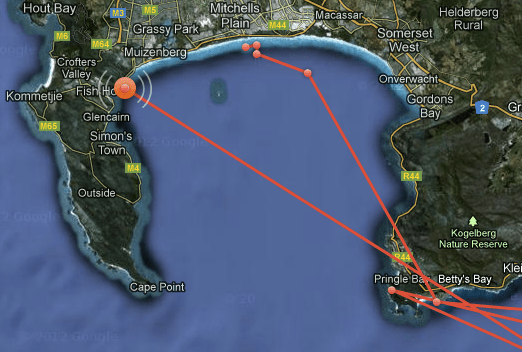
Shark spotters were put on alert Saturday in the Fish Hoek/Kalk Bay area in South Africa after a tagged great white shark was tracked swimming along the coast (see graphic).
The female shark, one of several great whites tagged by the nonprofit group OCEARCH, is named Lesley. She measured 13 feet, 8 inches and weighed 1,742 pounds when she was tagged off False Bay on April 15, 2012.
Knowing a great white is there is bound to make authorities nervous (they know they are generally there, but it is different when you have a position and track).
How long will it be before someone suggests preemptively capturing or killing Lesley? This is scientific research that aims to HELP sharks, but here’s what public safety officials are thinking about: the public outcry if a shark whose presence and whereabouts were known injures or kills a swimmer. For that reason, OCEARCH is potentially putting the great whites it tags into danger.
I’m sure OCEARCH has thought about this dilemma. I wonder how they plan to handle it, and whether it has already come up.
Jacques Cuisin, head of restoration at Paris’s Natural History Museum, said the damaged elephant skeleton would be repaired. Photograph: Joel Saget/AFP/Getty Images
The rhino and elephant horn poaching has got so out of hand, that even museum ivory is being targeted. Witness the recent attempt to escpae with the chainsawed tusk of an elephant once owned by Louis XIV, and on display at Paris’ Natural History Museum.
Visitors to Paris’s popular Museum of Natural History this weekend found a key exhibit under wraps after a man broke in and chainsawed a tusk from an elephant which once belonged to the Sun King, Louis XIV.
Police were called to the museum in the early hours of Saturday morning where they found a chainsaw still whirring after a man in his 20s escaped over a wall with a tusk over his shoulder. A police official said a neighbour of the museum on Paris’s Left Bank alerted authorities after hearing a strange sawing sound at around 3am. The museum alarm system was activated and startled the intruder into fleeing just minutes after beginning his chainsaw attack. He was treated in hospital for a fractured ankle from a fall while escaping and was being questioned by investigators.
Better keep an eye on your pianos. The only thing that has a hope of stopping this is a strictly enforced Chinese government ban on any and all ivory. But is any government, including the US, pressing this?




 The Earthist Chronicles