I realize that some people want much more action and they want it now. They are frustrated by the slow progress that is being made on the egregious and thoroughly unethical and inhumane murder of these amazing sentient beings. However, this press is a very good and much needed move for continuing to raise awareness of what is happening in Taiji. Many people really do not know about it. I surely understand the passion of those who want more and want it now. How could anyone sit back and let this brutal slaughter go on as if it isn’t really happening. It is, and countless gallons of the blood of these highly sentient beings are being spilled into the waters around Japan. Shame on those who kill the dolphins and shame on people who know about and who remain indifferent to this massacre. We all need to work together to stop the blood spills.
Those who share common goals must work for the animals and not against one another. There really is strength in numbers. For example, the frustratingly slow progress made over many years on gaining protection for chimpanzees is finally paying off (see also). A strong and unified community effort is needed to help the dolphins along and to stop this bloodthirsty, bloodcurdling bloodbath.
Hard to argue with that.
Here’s more from Bekoff on animal behavior and emotions:
Not that there was much doubt, but a scientific paper categorizes and defines the level of extreme cruelty. The DotEarth blog digs in:
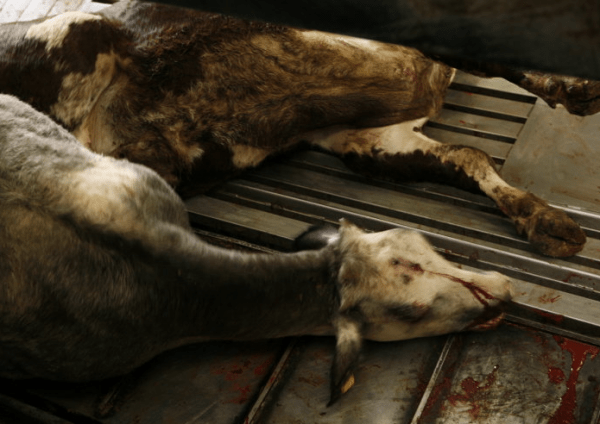
In a new peer-reviewed study, scientists assess the killing method employed by the dolphin hunters of Taiji, Japan, by watching video recorded surreptitiously in 2011 by a German dolphin-protection group, AtlanticBlue. The still image at right is from the video, which can be seen here (but be forewarned; this is not suitable for children — or many adults, for that matter).
Here’s the researchers’ not-so-surprising prime conclusion:
This killing method does not conform to the recognized requirement for “immediate insensibility” [some background is here] and would not be tolerated or permitted in any regulated slaughterhouse process in the developed world.
Annually in Japanese waters, small cetaceans are killed in “drive hunts” with quotas set by the government of Japan. The Taiji Fishing Cooperative in Japan has published the details of a new killing method that involves cutting (transecting) the spinal cord and purports to reduce time to death. The method involves the repeated insertion of a metal rod followed by the plugging of the wound to prevent blood loss into the water. To date, a paucity of data exists regarding these methods utilized in the drive hunts. Our veterinary and behavioral analysis of video documentation of this method indicates that it does not immediately lead to death and that the time to death data provided in the description of the method, based on termination of breathing and movement, is not supported by the available video data. The method employed causes damage to the vertebral blood vessels and the vascular rete from insertion of the rod that will lead to significant hemorrhage, but this alone would not produce a rapid death in a large mammal of this type. The method induces paraplegia (paralysis of the body) and death through trauma and gradual blood loss. This killing method does not conform to the recognized requirement for “immediate insensibility” and would not be tolerated or permitted in any regulated slaughterhouse process in the developed world.
DotEarth also puts a few questions to co-author Diana Reiss, and includes a bunch of other useful links on the topics of Taiji, dolphins and intelligence.
Q. One of the standard replies from Japan on this issue (whether with whales or dolphins) is that we, for example, cherish bison but eat bison burgers. Is there a distinction?
A. You cannot compare bison to dolphins in the cognitive domain. However, bison are not killed in this inhumane manner. Nor are lab rats. In cases in which animals are domesticated for food, most modern countries are striving for better animal welfare practices that minimize pain and suffering during the killing process with the goal to render an animal unconscious quickly before it is killed. This is not the case in the dolphin drive hunts. These are not domesticated animals; they are wild dolphins that are captured within their social groups, mother and young, and slaughtered using a technique that actually prolongs death, pain and suffering. The herding procedures themselves are inhumane and may include forced submersion as the dolphins are dragged by their tails to shore to be killed.
This is not to say that dolphins should be killed. They should not.
This is probably the best answer Reiss could give to the contradiction of supporting animal rights and welfare for certain species, but eating meat produced by practices that are also cruel and inhumane. And I agree that the dolphin slaughter should be stopped quite apart from livestock slaughter.
But it is not really a satisfactory or convincing answer. There is a moral contradiction in eating meat while expressing outrage at the abuse and cruelty involved in the slaughter of other species. You can try to defend one species but not another by creating different categories of animals based on intelligence. But while cows and pigs might not be as intelligent as dolphins, they are sentient beings. They know fear. They know loss. To die is painful and they resist that fate as ardently as any species, no matter how intelligent. In the end, the only position which truly avoids this moral contradiction is to oppose animal slaughter and cruelty for all species.
So what kind of killing WOULD be acceptable? It is absolutely offensive that anyone who works in the dolphin captivity industry would feel they have anything worthwhile to say about the Taiji dolphin drives. This is not about dolphin welfare any more than murdering humans is. This is about dolphin rights. But those in the captivity industry will continue to milk the welfare issue because it provides them a way to appear to be concerned about Taiji while still supporting the industry that drives the Taiji slaughters.
This video, which was used in the study (Warning: GRAPHIC) is horrific. But I could show you (and have) any number of videos of cows and pigs being slaughtered that you will find equally revolting and objectionable:
Italian photographer Francesco Scipioni spent a day photographing the workings of a slaughterhouse. The experience compelled him to make a change in his life: he became a vegetarian.
Mercy For Animals is one of the best outfits fighting animal cruelty in factory farms, and opening consumers’ eyes. And apparently they make a great year-end video too.
At the end of this you can almost believe there will be a time when most people are vegetarian, and factory farms are a distant and ugly memory.
Let’s start the week on an upbeat note, with this video story, courtesy of Farm Sanctuary, about the bonds between an adopted calf and his accidental family.
It’s a sweet story, and also a reminder that it would be very hard for people to keep eating animals if they knew anything at all about their emotional lives. Meat-eating requires a purposeful ignorance, which the meat industry is only too happy to encourage.
If you want to know more about Farm Sanctuary, and the vision of its creator, Gene Baur, I’ve got you covered:
Okay, I’ve been sitting on this one a while because it is pretty tough to watch.
But I think it is very important to see and bear witness to reality (previous here and here) because images elicit an emotional and visceral reaction that words sometimes do not.
Here’s the backstory on this video:
Aug. 21, 2012: An undercover video, filmed by a Compassion Over Killing investigator, exposes rampant animal abuse and suffering inside Central Valley Meat Co. (CVM), a slaughterhouse in Hanford, California. CVM is a major supplier to the USDA’s National School Lunch Program and other federal food initiatives.
Like all federally inspected slaughterhouses, CVM is required to comply with federal animal welfare requirements as well as California’s animal protection laws. However, COK’s whistleblowing video uncovers acts of cruelty that appear to violate both state and federal laws.
I do not post this lightly, but it IS what we call meat “processing” has come to–which is, to be blunt, animal torture. And it is too easy to just keep slinging hamburgers abetted by willful ignorance of what goes on behind the factory walls.
Do you really have faith that this sort of thing isn’t going on all over the world? Do you really want to keep eating meat that involves this degree of cruelty?
There are so many reasons not to eat meat. This is just one. But it should be all you need.
There has been a growing awareness over the past decade that circuses do not treat animals well. But this Mother Jones takedown of Ringling Bros. (and its corporate owner, Feld Entertainment), and the sad, tortured life of its elephants, will still make your stomach turn.
Elephants, like the orcas I have been writing about (here, and here), are highly intelligent and social animals. It’s hard to see how the experience of captivity can be anything other than stressful, and, ultimately, cruel. Here’s what Mother Jones discovered:
Feld Entertainment portrays its population of some 50 endangered Asian elephants as “pampered performers” who “are trained through positive reinforcement, a system of repetition and reward that encourages an animal to show off its innate athletic abilities.” But a yearlong Mother Jones investigation shows that Ringling elephants spend most of their long lives either in chains or on trains, under constant threat of the bullhook, or ankus—the menacing tool used to control elephants. They are lame from balancing their 8,000-pound frames on tiny tubs and from being confined in cramped spaces, sometimes for days at a time. They are afflicted with tuberculosis and herpes, potentially deadly diseases rare in the wild and linked to captivity. Barack, a calf born on the eve of the president’s inauguration, had to leave the tour in February for emergency treatment of herpes—the second time in a year. Since Kenny’s death, 3 more of the 23 baby elephants born in Ringling’s vaunted breeding program have died, all under disturbing circumstances that weren’t fully revealed to the public.
One key theme of the story, which echoes what goes on with regulation of the marine mammal industry, is the failure of the USDA to adequately oversee and enforce laws meant to protect animals. That sort of regulatory capture is depressingly common across many industries these days. But there is a simple solution that doesn’t rely on careerist, angling-for-a-high-paying-industry-job, bureaucrats: stop going to circuses and parks that use captive animals to entertain you. It’s your dollars that drive the profit. No dollars. No profit. No industry.
The Traveling Exotic Animal Protection Act (TEAPA) is a historic first for the U.S., and this Bill, which has attracted bipartisan support and been sponsored by Congressman Jim Moran (D-Va), aims to restrict the use of exotic and wild animals in traveling circuses, effectively bringing to an end the random cruelty and neglect associated with circuses of this nature. It is the first bill to comprehensively tackle the use of all wild animals in US circuses ever to be launched in the U.S.
I guess Moran has never been to a marine park. In any case, there’s a long way from introduction to passage in both the House and Senate. Anyone betting this one will get through? Thought so. More here.



 There has been a growing awareness over the past decade that circuses do not treat animals well. But
 The Earthist Chronicles