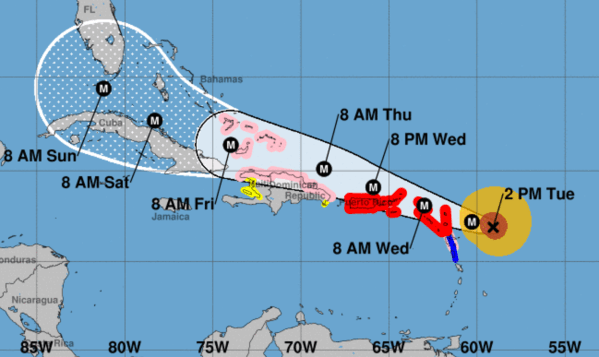
The Florida Keys are now under an evacuation order. Leaving the dolphins in their net pens has risks (if the pens get torn up they can tangle up the dolphins and drown them). So does letting them out into open water, which is the preferred protocol, and the dolphins usually show up again looking to be fed. During Hurricane Andrew, DRC opened the gates. One dolphin, Anessa, chose never to return.
Of course, Miami Seaquarium, and Lolita, are also at risk. During Andrew a wall of water washed through the facility.
Especially dangerous times for captive marine mammals in Irma’s path of destruction.
It won’t surprise anyone to know that I believe in the power of documentaries to tell a story that needs to be told, to illuminate, to change minds, and to inspire people to take action. Not every documentary sets out to do that, or achieves that. But I love the fact that there are so many creators out there working to use the medium to make the world a better place. As I have learned, it is perhaps the most effective medium for our visual, streaming, social media age (though it still starts with the written word!).
One new documentary that definitely illuminates, though it doesn’t come up with any easy answers (which makes it very honest) is Trophy, which opens in theaters September 8. In the words of the producers:
Trophy is a startling exploration of the evolving relationship between big-game hunting and wildlife conservation that will leave you debating what is right, what is wrong and what is necessary in order to save the great species of the world from extinction.
I do think the film delivers on this promise, and it beautifully conveys the complexity of the terrible choices before us as poachers and land changes relentlessly diminish the planet’s extraordinary bounty of beautiful beings. I came away devastated by the fact that the human relationship with the wild is so broken that we are even forced to consider whether canned big-game hunting–no matter how odious and self-serving the hunters are–or rhino horn farming, might really be beneficial to the future of lions, elephants and other big game.
The case for rhino horn farming (horns are harvested from the rhinos every few years in a relatively painless way) appears reasonably solid to me–no doubt aided by the passion and determination of the sympathetic rhino breeder featured in Trophy. A legal, sustainable international rhino horn trade would arguably have an impact on reducing rhino poaching, and that would save rhino lives because farming horn involves breeding and nurturing the lives of the animals while poaching means brutally killing the animals.
However, the case for high-value, canned, big-game hunts is harder to stomach. The hunters, their families, and the community around them are egotistical, crass, and thoroughly repulsive (as they cynically quote the bible, giggle their way through hunts, and then shed tears over the beauty of the animal they have just put a high-powered bullet through at virtually no risk to themselves). And it is abundantly clear that they don’t really care about conservation beyond the idea that it means sustaining species that they want to be able to add to their trophy walls.
Still, however much we dislike them (my son and I took to referring to Philip Glass, the hunter who is most featured, as “the dickhead”), it is not as easy to dismiss the fact that at least some of their dollars do in fact help fund anti-poaching and conservation efforts. That does not just come from their mouths, but from the mouth of a very thoughtful, very conflicted, anti-poaching unit leader in Zimbabwe. The choices are indeed hard, and hard to contemplate. But they are the choices a few centuries of industrialization, free market capitalism, rampant materialism, rampant population growth, and a thorough disregard for the natural world have left us with.
One very important policy goal that is simple to understand and simple to get behind, which sets the context for this crisis, is poverty. Trophy does not directly address the role of poverty in the ongoing extinction crisis, but it hints at it when it takes us into a poaching family’s destitute dwelling. It is very easy for anyone who is comfortable and well-fed to rail against the killing of wildlife and the assaults of humanity against the natural world (and I am describing myself, too!). But it seems clear to me, at least, that none of us will get very far in addressing the difficult and depressing problems raised by Trophy unless we, and the developed world as a whole, are prepared to address the underlying problem of extreme income inequality. It is poverty and desperation, and the need to feed one’s family, that often drives a young man into poaching. Or a farmer to kill a lion. Addressing that problem will take a quantum shift in how the wealthy nations of the world view our responsibilities to the global community and its impoverished nations, and a reassessment of what we are willing to sacrifice to achieve the conservation goals we all care so much about. (Along with a quantum shift in the moral consideration we give nonhuman species).
Millions of dollars from fat cat hunters from Texas may help buy some anti-poaching gear, or help preserve a slice of habitat. But it is a drop in the bucket compared to the income flows it would take to really solve the ongoing crisis of the relentless destruction of the great species and the environments they need to thrive.
I hope someone is making a documentary about that.
This Washington Post story does an excellent job of running through the timeline of SeaWorld’s public and private actions in response to Blackfish. And, yes, they shamelessly (and maybe illegally, it turns out) tied themselves in knots to reject or downplay any Blackfish effect, even while insiders sold shares:
In reality, the company was waging a serious campaign — and leveraging considerable money — against the “’Blackfish’ effect.”
The complaint accused the company of feeding employees lines to use regarding the film and instructing them to “dissuade family and friends” from watching. SeaWorld executives also hired a public relations firm to handle the criticism, and one executive reached out to ultimately 50 major film reviewers to discredit “Blackfish.”
In 2014, the company provided the funding for a website that also aimed to discredit the movie, and SeaWorld would also eventually task employees with infiltrating PETA and other animal rights groups.
But following the IPO, the company maintained the film was no cause for alarm and had not sparked backlash against the brand. On Aug. 29, 2013, a company executive told the Los Angeles Times “’Blackfish’ has had no attendance impact.” The same executive told Bloomberg SeaWorld “can attribute no attendance impact at all to the movie.”
To me, this sort of baldfaced denial is a powerful reminder of just how arrogant SeaWorld was (both its corporate culture and its leadership) following decades of profits and unthinking adulation. The old guard running the place really didn’t believe anything could touch them. And now they may be called to account.
The below is from the New York Times “Watching” e-mail I get (which usefully helps sort the good from the bad in the streaming universe). Hard to imagine them advising “Skip if you don’t want to think a lot about racism.” Or poverty. Or how f*cked we are.
I guess climate change is still an optional existential threat.
I’m doing some reading as I try to frame a book project that will attempt to change the way we see (and therefore treat) animals, and there is an interesting, religious-based argument, that is not about animal rights so much as a plea for the exercise of mercy (which would makes us better humans, and better honor whatever God one believes in). In that context, I came across this prayer from Saint Basil in 375 AD:
Oh, God, enlarge within us the sense of fellowship with all living things, our brothers the animals to whom Thou gavest the earth in common with us. We remember with shame that in the past we have exercised the high dominion of man with ruthless cruelty so that the voice of the earth, which should have gone up to thee in song, has been a groan of travail.
It appears to me that 16 centuries (and free markets powered by industrialization) has brought arguably more cruelty and less shame. But even though I am an atheist I like very much the concept of “fellowship with all living things.” In fact I would extend that idea of fellowship beyond living things to living ecosystems, and the living planet and all its environments. From fellowship would flow respect, moral consideration and compassion. Then the voice of humanity would indeed be a beautiful song instead of a terrible groan.
Just another example of how industrial ag’s endless cycle of pairing new herbicides with new GMO strains leads not to a stable, safe ag system, but to poisonous unintended consequences:
Farmers are locked in an arms race between ever-stronger weeds and ever-stronger weed killers.
The dicamba system, approved for use for the first time this spring, was supposed to break the cycle and guarantee weed control in soybeans and cotton. The herbicide — used in combination with a genetically modified dicamba-resistant soybean — promises better control of unwanted plants such as pigweed, which has become resistant to common weed killers.
The problem, farmers and weed scientists say, is that dicamba has drifted from the fields where it was sprayed, damaging millions of acres of unprotected soybeans and other crops in what some are calling a man-made disaster. Critics say that the herbicide was approved by federal officials without enough data, particularly on the critical question of whether it could drift off target.
This is a perfect representation of a badly broken system, where profits, regulatory capture and the false lure of better farming through technology are devastating farmlands and the environments around them. Organic ag (or “regenerative ag” to be more cutting-edge) isn’t perfect. But it is definitely a superior model, which is why paying a bit more is worth the cost (eat a bit less, which is also good, to compensate).
I’ve long been bemused by the story of 52HZ, the off-frequency blue or fin whale that the human race somehow decided had to be lonely. It seems like such a bizarre example of how humans like to impose their own stories on animals they really don’t understand or know.
But I had no idea how many people 52HZ’s story (or the story that we assigned to 52HZ) truly mobilized and inspired until I read this story:
For all her scientific unease with the whole media circus, Daher admitted to me that, “It’s interesting, isn’t it, that people appear to identify with this whale?” There was a pattern to those who reached out to her, as if she could somehow help. “It’s amazing. I get all sorts of emails, some of them very touching, genuinely. It just breaks your heart to read some of them — asking why I can’t go out there and help this animal. We as humans, we are very softhearted, caring creatures. It’s mostly females who write to me — not always; I also get males — but there are a lot of females who identify, feeling they’re not part of a pack.”
The story is full of people who wrote plays, created art, set out to make documentaries or were otherwise inspired to take action thanks to 52HZ’s perceived loneliness. But I can’t help wondering what any of these people are really doing to help 52HZ and all the other whales who are inundated with human noise and pollution.
Are they forsaking seafood to restore ocean food chains and reduce stray fishing gear?
Are they reducing their consumption of container-shipped goods that has turned the oceans into noisy superhighways, and resulted in numerous ship strikes?
What changes to their lives have they made that might improve 52HZ’s life in some small way? I hope many (I know actor Adrien Grenier was inspired to start an ocean conservation foundation and at least struggles with the fact that his acting work celebrating conspicuous consumption is what gave him the resources to do so). A whale can’t do much with empathy.
It is the frequent disconnect between what people say they care about and what they actually do with the choices they make in their own lives that is absolutely central to what the planet will look like–and how 52HZ will fare–in coming decades.
I have a lot more changes to make (especially when it comes to carbon footprint), but in an effort to take some pressure off the oceans I stopped eating seafood years ago. I am also doing everything I can to NOT buy anything new. It makes me feel out of step with our culture. I sense my wife and kids experience a range of reaction from annoyance to mild understanding. And I have to make a concerted effort to not come off as too deranged.
But out of step is exactly where I want to be because being in step does 52HZ no good at all.
Nature is good for you in oh so many ways. So says Florence Williams in her upcoming book The Nature Fix, and in this Wall Street Journal preview essay. Sadly, we don’t behave as if we understand this, as two social scientists learned when they mapped where people are happy:
“[O]ne of the biggest variables for their subjects (who tended to be young, employed and educated) was where they were. They were significantly happier outdoors, especially in natural settings, than they were indoors, even when the researchers tried to control for the effects of being at work.
But there was a catch: Most of the participants didn’t behave as if they knew this, because they were rarely outside. They were indoors or in vehicles for 93% of their waking hours.
The Mappiness study reveals our epidemic dislocation from the outdoors—an indictment not just of the structures and expectations of modern life but of our self-understanding. As the writer Annie Dillard famously said, how we spend our days is how we spend our lives. Why don’t we do more of what makes us happy? Part of the answer is that we’re flat-out busy. But even when we have free time, we’re not always smart about how we spend it.
I have long been a believer in the connection between happiness, creative energy, and the outdoors. Put me on a bike or on a walk (throw in a dog for a multiplier effect) and I always come home feeling good and with at least three worthwhile insights into work or life. Put me on a boat and I come home transformed.
Busyness, as Florence notes, is a huge block to feeding our souls in the outdoors (and busyness is so often purposeless). Social media and cable news are also two indoor, soul-sapping, distractions (and connecting to social media while outdoors is a particularly odious felony). So do we have a formula for a better, happier, existence? I think we do: Fewer electronic distractions, less meaningless busyness, more time outdoors and unplugged. Pretty simple and pretty effective.
This (via my cousin Elizabeth) perfectly captures how I feel right now. (And she took the picture above to illustrate).
THE REAL WORK by Wendell Berry
It may be that when we no longer know what to do we have come to our real work,
and that when we no longer know which way to go we have come to our real journey.
The mind that is not baffled is not employed.
The impeded stream is the one that sings.
There is real work and a real journey ahead of me. But I am definitely baffled and trying to figure out exactly what to do and where to go! Perhaps I need to start singing….
Injection of human iPS cells into a pig blastocyst. A laser beam (green circle with a red cross inside) was used to perforate an opening to the outer membrane (zona pellucida) of the pig blastocyst to allow easy access of an injection needle delivering human iPS cells. (Salk Institute)
“The experiment, described Thursday in the journal Cell, involves injecting human stem cells into the embryo of a pig, then implanting the embryo in the uterus of a sow and allowing it to grow. After four weeks, the stem cells had developed into the precursors of various tissue types, including heart, liver and neurons, and a small fraction of the developing pig was made up of human cells.
The human-pig hybrid — dubbed a “chimera” for the mythical creature with a lion’s head, a goat’s body and a serpent’s tail — was “highly inefficient,” the researchers cautioned. But it’s the most successful human-animal chimera and a significant step toward the development of animal embryos with functioning human organs.”
If that sounds creepy to you that it is because it is creepy, very creepy. And I can only imagine what “highly inefficient” is a euphemism for. Yet again, we have a perfect example of technology rushing forward because it can, before the ethical implications can be well understood.
And yet again, it is human interests and needs, with no real consideration of the interests of the other species involved, that is the driving force:
“Researchers hope that one day doctors may be able to grow human tissue using chimera embryos in farm animals, making organs available for sick humans who might otherwise wait years for a transplant.”
Now imagine a factory farm of sows, all nurturing chimera fetuses which can be harvested for human organ transplants. When are the fetuses harvested? How? When and how are they euthanized or killed? What happens to the sows?
There is a heated and growing ethical debate about the wisdom of these techniques, but some bioethicists are already arguing that the benefits these techniques are demonstrating for human health justify the means. That presupposes that you value human life and experience highly, and animal life and experience not much at all. And that is the real problem here.



 The Earthist Chronicles