SeaWorld Had Problems Beyond Blackfish

Theme Park Insider publishes an excellent breakdown and analysis of SeaWorld’s attendance numbers since 2009. Here are the numbers for SEAS four largest parks:

SeaWorld Orlando
2009: 5.8 million
2010: 5.1 million
2011: 5.2 million
2012: 5.3 million
2013: 5.0 million

SeaWorld San Diego
2009: 4.2 million
2010: 3.8 million
2011: 4.2 million
2012: 4.4 million
2013: 4.3 million

Busch Gardens Tampa
2009: 4.1 million
2010: 4.2 million
2011: 4.2 million
2012: 4.3 million
2013: 4.0 million

Busch Gardens Williamsburg
2009: 2.9 million
2010: 2.8 million
2011: 2.7 million
2012: 2.8 million
2013: 2.7 million

You can see that the SeaWorld parks suffered their biggest attendance declines 2009-2010, before Blackfish. My guess is that the numbers reflect a combination of families feeling the pinch of the Great Recession plus the negative publicity that followed Dawn Brancheau’s death in February 2010. And attendance never really recovered, and then declined again in 2013 when Blackfish starts to hit the public consciousness (and attendance was off another 4.7 percent for the first nine months of 2014).

So why did SeaWorld’s numbers never make a recovery from 2010? Bad management, and a failure to come up with attractions that could compete with what other parks were rolling out, according to Theme Park Insider:

While other theme park companies have moved aggressively to develop new attractions and intellectual property in the wake of the Great Recession, the SeaWorld/Busch Gardens parks have stumbled through one challenge after another. The debuts of the two Manta roller coasters, in Orlando in 2009 and San Diego in 2012, provide the few bright spots during this period. Otherwise, the parks have suffered through construction delays on multiple new attractions, including missed projected open dates for major new drop towers in Williamsburg and Tampa.

Looking back through our Theme Park Insider reader ratings, I can’t find a single example of a new show debuting during this time period at any of these four parks that scored a higher reader rating than the show it replaced. In 2013, SeaWorld Orlando made what it called the largest capital investment in its history in opening Antarctica: Empire of the Penguin. An effort to compete with the engaging and immersive environment of Universal Orlando’s Harry Potter land, SeaWorld chose to go with depicting what might be the most inhospitable environment on Earth: Antarctica. Sure, people love penguins, but SeaWorld’s technically innovative Antarctica ride left visitors spending too much time spinning around in low-light caverns with there were no penguins in sight, rather than spending time with cute new penguin character SeaWorld had created for the attraction. At the end of the ride, SeaWorld crafted a new, open display environment for its penguins, but doing show required keeping the guest areas in the exhibit so cold that few visitors could stand spending more than a moment or two looking at the pavilion’s most compelling attraction — the live penguins themselves.

Not good.

That said, I think the #BlackfishEffect has become a bigger part of the story in 2013-2014. Throw in the investor lawsuits, and ongoing grassroots opposition to killer whale entertainment, and it becomes clear that whoever comes in to replace Jim Atchison as CEO has a very complex puzzle to solve.
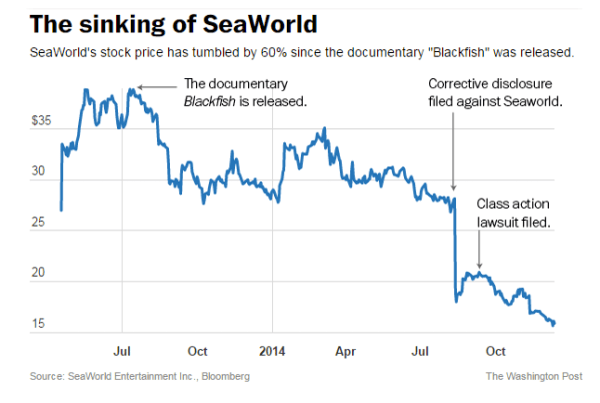
WashPost Wonkblog Charts The Blackfish Effect

Sure, sure. Correlation is not causation. But it’s still worth looking at and considering the correlation, so thanks Wonkblog.

Screen Shot 2014-12-12 at 3.52.31 PM

Here’s Wonkblog’s setup:

Jim Atchison, the chief executive of SeaWorld Entertainment, which operates SeaWorld theme parks, resigned Friday morning. Atchison’s departure comes on the heels of what has been a terrible year for the company. In the first nine months of 2014, SeaWorld’s revenue fell by more than seven percent, and its attendance dropped by nearly five percent.

The changing of the guard is likely the result of something that occurred in July 2013: namely, the release of the documentary “Blackfish.”

“Blackfish” was met with both critical praise and public uproar. The documentary depicted cruel treatment of the orca (or killer) whales that SeaWorld holds in captivity and features among its biggest attractions. It was seen widely. And the response has been paralyzing (even despite an effort to discredit the documentary).

Personally, I think that there is more going on with SeaWorld’s drop in attendance and share price crash than Blackfish (though I do think Blackfish and the investor lawsuits at least partly account for it). Consider, also, that SeaWorld has basically been offering the same show for 50 years, and today it is even less thrilling since trainers are no longer leaping off orcas. Throw in a general public sensibility that increasingly questions the exploitation of animals for entertainment (at circuses and zoos, as well as at marine parks), and you can see why Shamu might not have the same drawing power as Harry Potter World.

So, does Atchison’s departure signal that SeaWorld might be ready to make big changes? I did an interview with NPR’s All Things Considered today, to discuss Atchison’s ouster. I said I suspected the most likely change is that SeaWorld will over time start to move its killer whale entertainment business abroad to more willing audiences in Russia, Asia and the Middle East. But one thing I should have mentioned to Greg Allen, the reporter, is that the only certain signal that SeaWorld plans to reinvent itself and evolve away from killer whale entertainment as the core of its business and brand would be a cessation of killer whale breeding. No breeding means that eventually there will be no captive killer whales. Anything else is just spin aimed at somehow perpetuating the Shamu Show, whether here in the US or abroad.

All Animals Go To Heaven

“Sure, why shouldn’t animals should get in on all this?”


I don’t believe in heaven. But I am glad to know that the Pope believes that all God’s creatures have a place there:

Trying to console a distraught little boy whose dog had died, Francis told him in a recent public appearance on St. Peter’s Square, “Paradise is open to all of God’s creatures.” While it is unclear whether the pope’s remarks helped soothe the child, they were welcomed by groups like the Humane Society and People for the Ethical Treatment of Animals, who saw them as a repudiation of conservative Roman Catholic theology that says animals cannot go to heaven because they have no souls.

“My inbox got flooded,” said Christine Gutleben, senior director of faith outreach at the Humane Society, the largest animal protection group in the United States. “Almost immediately, everybody was talking about it.”

Charles Camosy, an author and professor of Christian ethics at Fordham University, said it was difficult to know precisely what Francis meant, since he spoke “in pastoral language that is not really meant to be dissected by academics.” But asked if the remarks had caused a new debate on whether animals have souls, suffer and go to heaven, Mr. Camosy said, “In a word: absolutely.”

And whether you believe in heaven or not, any debate over whether animals can suffer, and have feelings and awareness (if not souls) is a good debate to be having.

Oceans Of Plastic

This stuff is ashore so it doesn’t even count.


Dr. Evil, who deals only in millions, would be shocked by this:

A major new study of the world’s oceans has reached a shocking conclusion: Thanks to humans, there are now over 5 trillion pieces of plastic, weighing more than 250,000 tons, floating in water around the world.

With a global population of about 7.2 billion, that’s nearly 700 pieces per person.

The study, published in the journal PLOS One by Marcus Eriksen of the Five Gyres Institute in Los Angeles and a large group of colleagues, is based on data from 24 separate ocean expeditions, conducted between 2007 and 2013, to sample plastic pollution. Plastic was either observed from boats, or hauled up from the ocean by nets, in 1,571 locations. The data were then used to run an ocean model to simulate the amount and distribution of plastic debris.

That’s a nearly incomprehensible amount of plastic. What’s worse, though, is that there is probably a lot more than that:

The authors stress that they suspect their estimate is “highly conservative” — there could be a lot more plastic out there than that. For as they note, there is also a “potentially massive amount of plastic present on shorelines, on the seabed, suspended in the water column, and within organisms.”

In particular, the authors cite a figure from the trade group Plastics Europe, which suggests that 288 million tons of plastic are produced annually. Compared to a figure like this, the 250,ooo tons described in this study represent “only 0.1 % of the world annual production” — again underscoring that the numbers reported in the study, large though they are, are probably a low end estimate.

The American Chemistry Council responded to the study by stressing the importance of recycling. Okay, hard to argue. But with these sorts of stories about humanity laying waste (literally) to the planet, I keep coming back to the same thing. Consumables need to be priced differently, to reflect their environmental impact and cost. Adopting that approach–which is the only thing that radically changes industry and consumer behavior–is really the only hope of limiting human impact on the planet.

In the meantime, I will put plastic alongside the internal combustion engine as a two-edged human invention that created wealth and progress while simultaneously destroying natural capital.

Why Do We Continue To Abuse And Exploit Animals?

It’s a profoundly important question. I tend do go with the simple explanation that we can, we have retrograde beliefs about the moral consideration we should give animals, and doing so often yields profit or profits human in some way (allowing them, for example, to go around saying “MMMM. Bacon.”).

But Dr. Lori Marino and Michael Mountain go deeper. In an attempt to better understand our very troubled relationship with the other species on the planet, they argue that awareness of our own mortality plays a role. The result is a paper for Anthrozoos called “Denial of Death and the Relationship Between Humans and Other Animals.

Here is the abstract:

The focus of this paper is to explore how cultural anthropologist Ernest Becker’s claim that human behavior is largely motivated by fear of death may explain important aspects of our relationship with nonhuman animals. Terror Management Theory (TMT) suggests that when we humans are reminded of our personal mortality, we tend to deny our biological identity or creatureliness and distance ourselves from the other animals, since they remind us of our own mortal nature. In support of this, an abundance of peer-reviewed experimental literature shows that reminders of our own mortality create a strong psychological need to proclaim that “I am not an animal.” We contend that the denial of death is an important factor in driving how and why our relationships with other animals are fundamentally exploitive and harmful. Even though today there are more animal advocacy and protection organizations than ever, the situation for nonhuman animals continues to deteriorate (e.g. more factory farming, mass extinction of wildlife species, and ocean life under severe stress). We also suggest that developing a new and more appropriate relationship with the natural world would be a key factor in resolving the question that Becker was never able to answer: How can we deal with the existential anxiety that is engendered by the awareness of our own mortality?

Got it? Michael Mountain, in a blog post, explains further, in an effort to better understand whether this dynamic can help explain the disastrous and destructive trajectory of the human race:

Why are we doing this? Why have we created a way of living that’s destroying the only home we have and bringing on a mass extinction that will most likely consume us, too? And all in the name of “progress.” Why can’t we stop?

Those are the questions Dr. Lori Marino and I set out to answer in a paper that will be published in March in the journal Anthrozoos, but is already fast-tracked online here. (You need a subscription to Anthrozoos to access the full text.)

The paper, entitled Denial of Death and the Relationship between Humans and Other Animals”, explores the psychology of how and why we humans feel compelled to treat our fellow animals as commodities and resources – and the whole natural world as our property.

The reason lies at the core of the human condition. It’s probably best summed up by the French author Albert Camus, who wrote:

“Humans are the only creatures who don’t want to be what they are.”

And what we absolutely don’t want to be is an animal.

Our central problem, as humans, is that as much as we reach for the stars and create profoundly beautiful works of art, we cannot escape the knowledge that, just like all the other animals, we are destined to die, go into the ground, and become food for worms.

In his Pulitzer Prize-winning book The Denial of Death, social anthropologist Ernest Becker wrote that the awareness we humans have of our personal mortality creates a level of anxiety that drives much of our behavior. Certainly other animals experience bursts of terror in the face of death, but for us humans it’s a lifelong awareness, and one that brings about a chronic level of anxiety.

And so, to alleviate the anxiety we feel over our animal nature, we try to separate ourselves from our fellow animals and to exert control over the natural world. We tell ourselves that we’re superior to them and that they exist for our benefit. We treat them as commodities and resources, use them as biomedical “models” or “systems” in research, and force them to perform for our entertainment.

I personally am comfortable with my animal nature (though that doesn’t mean I don’t try to better understand it and resist its more aggressive tendencies). And I experience joy at the connectedness I feel with regard to other creatures.

That connection is where true empathy comes from, and is the foundation of the idea that while we may be more powerful than other species our power should not be mistaken for moral superiority or the right of dominion. In fact, our power to dominate (and destroy) should be the moral basis for greater consideration and care for other species. We should be stewards, not exploiters. But since that is clearly not a view that our global culture accepts or promotes, I am glad that Lori Marino and Michael Mountain are making a bold intellectual bid to explain why.

Another Account Of Penn Cove

Peter Ward, a paleontologist, writes an account of his life in science. Part of his journey included working for Don Goldsberry and Ted Griffin during the Penn Cove captures. Here is what he has to say about the experience:

In 1970 and 1971, I was part of the infamous Penn Cove (Washington) whale hunts. At that time the Puget Sound region, or its salmon-fishing community, despised the orca, which routinely ate half the salmon returning each year to spawn. Trapping was applauded. We encircled pods of 30 to 40 whales with seine nets thrown from fishing boats, and culled and captured with ropes the babies for aquaria. My job was to be in the water with the whales and separate mothers from their young. (I once found my leg down the throat of an enraged mother, who spit me out). Rumor had it the going price for an orca was $50,000. I was paid $50 a day.

But another part of my job was to dive down into the seine nets at night, should the whales try to break out. During those nights I learned more about fear than I ever wanted to know—down 40 feet in low visibility, with a dive light in one hand and a knife in the other to confront the poorly seen but certainly felt struggles of a gigantic, multi-ton behemoth fighting for its life in a heavy net, its massive tail thrashing through the blackness. We mostly succeeded in cutting the whales loose from the nets. But not always. That brought about shame, followed by rage, at myself, and at the greedy, voracious men who then, as now, make money from the incarceration of these intelligent creatures.

Following an expose of the hunts by Seattle TV news reporter Don McGaffin in 1971, some of my fellow divers and I testified to state authorities that our employers had been covering up evidence of whales killed in the hunts. Our proof helped launch a state and then federal law to prevent capturing whales in U.S. territorial waters and giving them a life sentence in solitary confinement. It remains the most important work of my life: helping stop the obscene captures.

It’s always interesting to get a new perspective on Penn Cove. But Ward’s real purpose in his article is to pay homage to the nautilus, the extraordinary and (up until humans come into the picture) resilient mollusc he has spent a lifetime studying:

In 2011 and 2012 I returned to my old study sites in the Pacific, and collected DNA samples that helped confirm that Nautilus pompilius is many separate species. But I also discovered that unlike in the deep past, perhaps only a few thousand individuals make up each species. A few thousand individuals swimming long distances to be caught in a baited trap, from which they are hauled to the surface, killed, and sold for $1 a shell. For buttons and cheap tourist jewelry.

It’s a savage irony. Although the nautilus ruled the oceans for hundreds of millions of years, Earth’s changing conditions dwindled the number of species, about 3 million years ago, to less than a handful—or even a single species. Then came the advent of the Ice Ages and a radical drop in global sea level and temperatures, which, combined, created cool, highly oxygenated oceanic conditions similar to those when hundreds of nautiloid species existed. The nautilus was making a huge comeback in diversity, to the point where it may have been poised to once again be a presence in every ocean, rather than its current confinement to the western tropical Pacific.

But as recently as 50 years ago, the comeback hit a roadblock: us. In the Philippines and  Indonesia, the distant nautilus species are being harvested to extinction. Between 2007 and 2010, the United States Department of Fish and Wildlife discovered that more than half a million nautilus shells or artifacts were imported into the United States alone. Fleets of nautilus boats now scour the coastlines of the South China Sea.

The life of the nautilus is providing its last lesson about chance events. But this time it’s about bad luck. It’s bad luck that nautiluses use their olfactory system rather than vision to find prey, because this trait makes them ludicrously easy to catch. Worse luck comes from a trait over which they never had control: they produce a shell with a visual power that humans covet.

Killer whales. The nautilus. The destructive power of human desire crosses all species.

The Wonder Of Whales (And Nature)

A beautiful homage to the infinite complexity of Nature, and a reminder that it is hubris to act as if we understand the most subtle workings of the planet.

From the summary:

“When we try to pick out anything by itself, we find it hitched to everything else in the Universe.” – John Muir

When whales were at their historic populations, before their numbers were reduced, it seems that whales might have been responsible for removing tens of millions of tonnes of carbon from the atmosphere every year. Whales change the climate. The return of the great whales, if they are allowed to recover, could be seen as a benign form of geo-engineering. It could undo some of the damage we have done, both to the living systems of the sea, and to the atmosphere.

Everything we do has implications for the planet and its regulatory systems. Tread lightly, lightly…

(h/t Cetacean News Network)

GoPro Hero Series: Orca Rescue

Starring our pal Dr. Ingrid Visser. Some amazing and inspired footage once you get through the classroom stuff at the beginning (disclosure: I fast-forwarded; sorry, Ingrid!).

Here’s GoPro’s summary:

The sixth and final of the HERO4: The Adventure of Life in 4K series.

Dr. Ingrid Visser dedicates her life and her research to help the most intelligent predator on earth – Orca. She swims with wild orca and advocates for modern solutions to release orcas from captivity.

Shot on location in New Zealand, this short film documents Ingrid’s life mission to preserve wild orca through education & leading rescue missions to save orca from shallow waters & fishing line entanglements.

Includes never-before-seen footage of a GoPro mounted to the dorsal fin of a wild orca plus various archival footage and pictures from the Orca Research Trust.

Humanely-Raised Chickens Is An Oxymoron

Here’s what Jim Perdue says about the chickens he sells:

Here is what a chicken farm that follows Perdue’s guidelines to the letter looks like:

How can there be such a discrepancy? Well, industries spin the facts, of course. And more important, consumers misunderstand the labels used by the industry, and the standards that do exist are mostly set by the industry:

Perdue sells its chicken with a label that says both “humanely raised” and “raised cage free.” The former claim seems debatable, especially considering how nearly one million of its birds are being raised each year—whether within the company’s guidelines or not. And the latter is arguably misleading, because it applies to virtually all chicken meat sold in the United States. Egg-laying birds are often raised in cages, but broiler chickens—those raised for slaughter—are not. In that sense, marketing that chicken meat comes from chickens that were “raised cage free” isn’t all that different from touting the fact that coffee beans were not grown in Siberia (coffee beans, for the record, are not grown in Siberia).

The problem is that these claims, however misleading they might be, are actually pretty effective sales pitches. A recent survey showed that the vast majority of consumers prefer cage-free “humanely raised” labels, according to Kristof.

Compassion in World Farming isn’t shy about placing some of the onus on the USDA. The government does have a list of labels that must meet certain requirements in order to be used by meat producers on their packaging, such as “organic,” “free range,” and “no antibiotics.” But the terms that Perdue is using, like “humanely raised” and “raised cage free” aren’t regulated by the government in the same way. Instead, they are based on The National Chicken Council’s animal welfare guidelines, an industry-created standard.

The USDA doesn’t approve the label so much as verify that it meets the standards the industry decided it should meet. Samuel Jones, a spokesperson for the USDA, confirmed the process. “Some companies pay the USDA to verify that they’re meeting specific processing points,” he said. “If it’s cage-free, and they want us to verify that they are meeting their set guidelines, that’s what we do.”

It would of course be nice if the USDA actually set much better and stricter standards for the raising and slaughter of livestock (while there is one decent independent certification, I don’t think any standard can actually make the process “humane”), instead of being a rubber stamp for the meat producers and processors.

But I mainly put the onus on consumers. These days, with all the video and reporting that repeatedly exposes the tortured lives of the animals the public consumes with such gusto, you have to be willfully blind to not be aware that if you are eating meat, eggs, or dairy you are almost certainly the last link in a very profitable chain of misery.  Or you have to be a person who DOES know the truth but somehow can’t bring yourself to the ethical and logical conclusion that you should stop eating meat.

Nick Kristof, for example, did indeed write a great op-ed about Perdue and the Perdue farmer who blew the whistle on how Perdue’s guidelines added up to chicken-abuse. But just when you think Kristof is about to bring his column to a logical conclusion and tell his millions of readers that chicken is now off his menu, he comes up with this:

Perdue’s methods for raising chickens are typical of industrial agriculture. So the conundrum is this. Big Ag has been stunningly successful in producing cheap food — the price of chicken has fallen by three-quarters in real terms since 1930. Yet there are huge external costs, such as antibiotic resistance and water pollution, as well as a routine cruelty that we tolerate only because it is mostly hidden.

Torture a single chicken and you risk arrest. Abuse hundreds of thousands of chickens for their entire lives? That’s agribusiness.

I don’t know where to draw the lines. But when chickens have huge open bedsores on their undersides, I wonder if that isn’t less animal husbandry than animal abuse.

You think? And I think the line is pretty easy to draw: stop eating chicken. James McWilliams wrote a brutal and scathing takedown of Kristof’s lack of moral courage, that is well worth reading. I’d only add that if the facts can’t get a smart, thoughtful columnist like Nick Kristof to stop eating abused animals it’s a pretty discouraging indicator of how meat-eating and the meat-eating culture somehow detaches us from ordinary moral calculation. And that’s a bad thing for billions of animals.

Does SeaWorld Do Much For Wild Orcas?

“I’ve certainly never seen a SeaWorld researcher.”


Not really, writes Tasneem Raja in Mother Jones:

Yet independent orca researchers say these arguments don’t hold water. “If SeaWorld didn’t exist, would our understanding of wild killer whales be significantly reduced? I think the answer to that is no, it would not,” says a veteran marine-mammal researcher who works at the National Oceanic and Atmospheric Administration. “It’s a bit like having Walt Disney tell us about mouse biology,” says Ken Balcomb, founder of the Center for Whale Research and a pioneering orca researcher.

Despite their 24/7 access to killer whales, SeaWorld-affiliated researchers have published relatively few orca studies. Of the four dozen orca-related papers coauthored by SeaWorld-backed researchers over the past 40 years, half were published before 1990, and just seven since 2010. What’s more, at least one-third of these papers did not focus on captive whales, but wild populations ranging from Alaska to New Zealand.

Many of the papers cited on SeaWorld’s website were coauthored by researchers from the Hubbs-SeaWorld Research Institute, a San Diego nonprofit founded in 1963. SeaWorld provides around 10 percent of its roughly $5 million budget. In 2012 and 2013, Hubbs-SeaWorld published 26 papers on topics ranging from abalone genetics to polar bears’ hearing; none focused on orcas. SeaWorld also touts its SeaWorld & Busch Gardens Conservation Fund as evidence of its investment in killer-whale science and conservation. However, between 2004 and 2012 the fund spent no more than $550,000 on research focused on killer whales, according to an analysis by the nonprofit Whale and Dolphin Conservation.

It’s well worth reading the whole thing.

At some point SeaWorld will realize that spin will no longer cut it. If they want credit for promoting conservation and a better understanding of threats to wild orca populations they will have to make real investments and do real research.