Seabird Slaughter

Fisheries don’t just kill fish:

Evidence for the horrific impact of fishing gear on seabirds has been revealed by the closure of Canadian fisheries after fish stocks collapsed in the early 1990s.

Biologists have long worried that diving birds can become entangled in gillnets, which are anchored in fixed positions at sea. Designed to snare fish by the gills, these nets can also trap and drown birds.

This has been graphically demonstrated by finds of birds enmeshed in nets, but a quantitative assessment of the effects of such ‘by-catch’ on seabird populations has been hard to come by.

Now, that hard evidence has come from a careful study of seabird populations off the eastern coast of Canada, where cod and salmon fisheries were closed and gillnets removed in 1992. This work comes just weeks after another report estimated that hundreds of thousands of birds die each year in gillnets around the world.

Ecologists Paul Regular and William Montevecchi of the Memorial University of Newfoundland in St John’s and their colleagues examined data on various marine birds at five major Canadian seabird reserves in Newfoundland and Labrador between 1968 and 2012. They then compared bird population trends with data on gillnet use between 1987 and 2009.

The team found that populations of diving birds such as murres and gannets, which are vulnerable to entanglement in nets, increased after the ban. But in the same period, the numbers of gulls and other surface-feeding scavengers that benefit from unwanted fish thrown away by fisheries decreased, the researchers report in Biology Letters. Although the gull populations declined, these species are not at risk of extinction and it is likely their numbers are returning to more natural levels with the reduced influence of human activity.

Hard numbers
“Based on previous estimates of tens of thousands of murres killed each year in regional gillnet fishes, clearly significant numbers of breeding murres have survived that wouldn’t have otherwise,” say Regular and Montevecchi. The data ”support the widely held but rarely documented contention that by-catch mortality affects seabird populations”.

Just one more reason to not eat fish–even if you can convince yourself that the fish themselves are being fished “sustainably.”

Annals Of Ugh!: Dolphin-Assisted Birth

You just can’t make this sh*t up:

Last month, Adam Barringer, 29, and his pregnant wife Heather, 27, boarded a plane for Hawaii. The couple traveled over 4,500 miles in the hopes of welcoming baby Bodhi into the world during a dolphin-assisted birth in Pohoa, Hawaii.

The couple will stay and study with Star Newland, founder of The Sirius Institute, a consortium with the purpose of “dolphinizing” the planet.

Heather and Adam’s idea to welcome their first child into the world via water and hopefully dolphins, was inspired by the book, “The Ancient Secret of the Flower of Life” by Drunvalo Melchizedek.

Before they learned they were pregnant, the idea of a water-and-dolphin birth appealed to Heather and Adam and they say they have experienced signs along the way, pointing them to Hawaii and the institute. Preparations for a dolphin-assisted birth began as soon as they arrived, long before Heather’s July due date.

At the institute, the couple will spend time in the water, forming a connection with a dolphin pod they hope will bond with them and ultimately their newborn.

“It is about reconnecting as humans with the dolphins so we can coexist in this world together and learn from one another,” says Heather.

Here’s more, if you think you can take it.

Just when you think you have seen every possible exploitation of dolphins in the service of human neediness…

(via)

The Ghost In The Water

A powerful look at how Gulf Coast communities are struggling to deal with the aftermath of the BP Deepwater Horizon blowout, and the oil–the “ghost in the water”–which continues to haunt their lives.

The nation’s attention and the media spotlight have moved on. But the hidden costs of this inevitable unintended consequence or our reliance on oil will keep piling up for decades. This is just part of the real price of oil and gas, the price that no political leader is willing to admit or apply at the pump.

Another Take On Morgan The PR Star

A few weeks back, I posted a video of Morgan that was created by Loro Parque, along with some quick analysis.

Here’s the video again:

One element of the video that caught people’s attention was the apparent use of a whistle to bridge Morgan, which bears on the question of Morgan’s alleged deafness.

Bridgette Pirtle, a former trainer at SeaWorld Texas, got in touch with her view of the video, and graciously allowed me to share it here:

[UPDATED] A few observations…  LoroParque chose some interesting footage to use to show how “well” Morgan is doing. Particularly towards the end, that video appears to give stronger evidence for how she is not acclimating well. The white water looks like displacement not play. Those wide eyes in the closing frames are consistent with behaviors seen in whales anticipating more acts of dominance directed towards her, not of one settling into the hierarchy. Her eyes are of a whale tight and uncomfortable in her social environment.  I understand Morgan has a unique history along with some physical disabilities that further distance her from a “regular” orca, but those behaviors are far from that of the ” happy-go-lucky” captive norm.  That’s a little more like throwing a Mizzou fan in the middle of KU country. That Tiger is blending in anonymously, hoping to make it through without any altercation.  All the while, that Tiger is always watching his tail.  The behaviors observed in this video are more consistent with those of learned helplessness rather than proof of her successful acclimation within the social environment of LoroParque.

In regards to earlier comments made suggesting a possibility of the trainers continuing to use auditory stimuli amidst claims of Morgan’s loss of hearing, I feel that this isn’t sufficient evidence to support any speculations of the conflicting claims of poor hearing yet continuing to use the bridge whistle.  The session with Jose and Morgan at the slideout isn’t a good indicator of the possibility of a whistle being used as a bridge.  Audio is edited and a trainer placing a bridge in his or her mouth doesn’t always mean guarenteed bridge.  I was always “chewing on my whistle.”  In fact, there is a video on YouTube with me and Halyn doing a hand target learn session for campers where I also go into explaining my habit to the group.  I feel the more noteworthy points to take home from this video are that actions viewed are not quite lining up with the words being heard. Although the audio is edited over, I can tell you from the years I worked with him, Jose definitely was just as bad as me at “chewing on the whistle.” Most likely that would get chopped up to a trainer’s superstitious bad habit. There had been a video on YouTube with Rafa using his bridge while working Morgan that would better prove they don’t even really believe their own spin on Morgan’s deafness. It actually may have been one of the first installments of LP’s promo porn regarding Morgan. 🙂

Regardless of whether or not there’s a presence of auditory cues or that there is any substance to Morgan’s situation being compared to that of the whale euthanized by a shotgun blast, I feel the footage incorporated into this LoroParque PSA isn’t necessarily in line with the idealistic image they hope to achieve.  Killer whale social structures are extremely dynamic and complex.  Morgan’s unique variables contribute even more variables and complexities into this already delicate balance.  I would think even an untrained eye would be able to identify the social happenings observed here as being anything but an all-in-all acceptance within her new pod.

This is like Kremlinology, from the bad old days. But it’s nice to have some real experts providing the analysis.

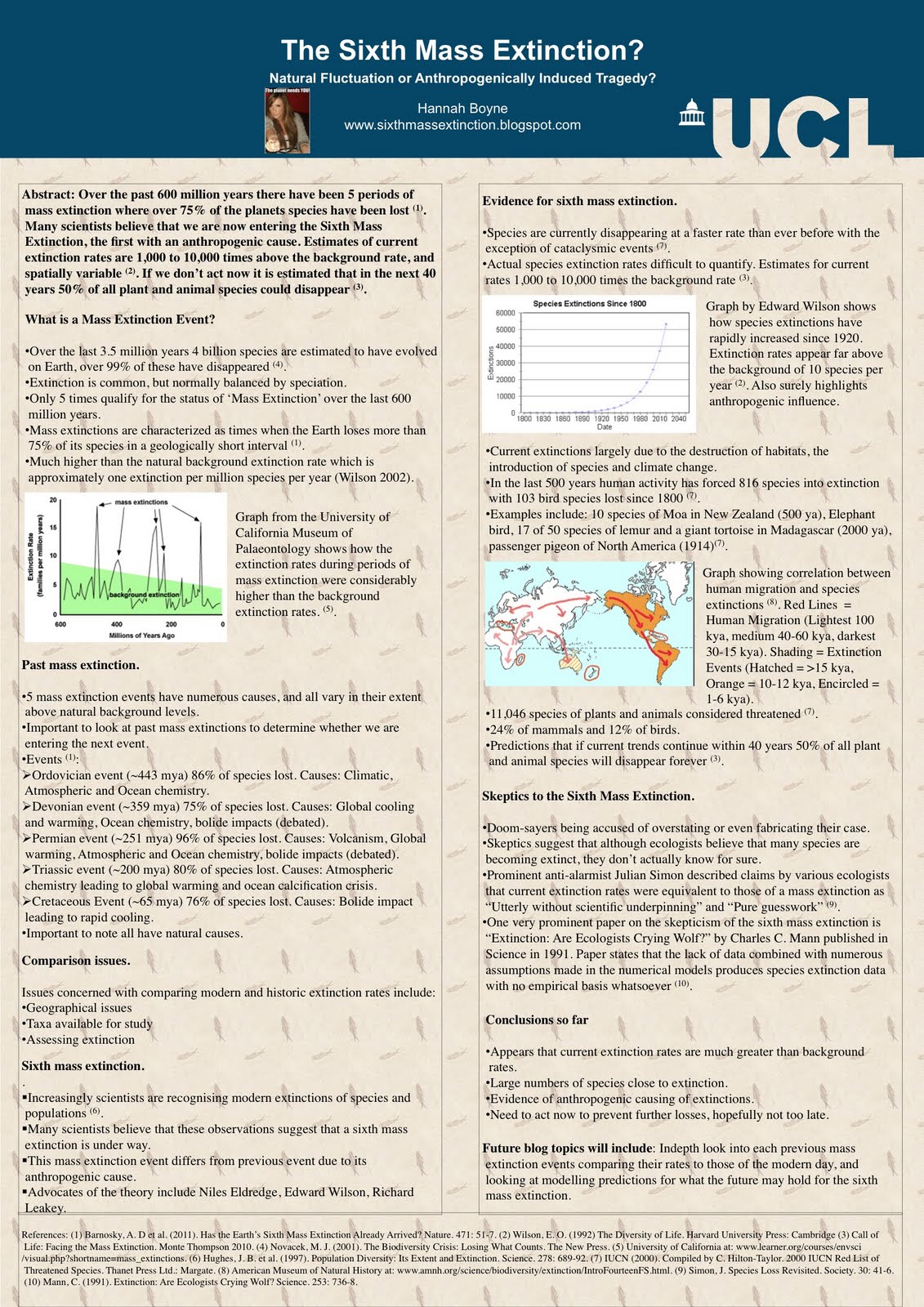
The Sixth Mass Extinction

Presented in one detailed poster (click image for full size)….


(via)

Can Humans Know What Animals Experience?

A few decades ago the idea of animal consciousness was radical. Today, the idea that animals have emotions, feelings, awareness is an idea that is changing our understanding of the relationship between humans and non-human animals. But Jeff Warren goes on to argue that we can go even further, that we can find points of connection to non-human animal experience:

“A feeling for the organism” is how the famous geneticist Barbara McClintock described her own intuitions about life. Empathy as a capacity needn’t end at the human genus. It seems to be more a question of how much energy and intelligence and openness you bring to the inquiry. Obviously, the further away you get from the human, the more room for fantasy – this is a genuine risk – but this doesn’t mean there isn’t also a real sensitivity that can be cultivated.

And indeed, when you pan out to the big picture of human knowledge, what you see are multiple lines of inquiry converging on this exact point. From the scientific world, we have the study of animal cognition and communication, as well as more cutting-edge domains like the study of animal sense worlds (or “umwelts”) and embodied cognition. From the philosophical world, investigators are beginning to elaborate a whole series of intriguing approaches, from “affordances” to the phenomenology of “interbeing,” to name just two ideas. All of these lay the groundwork for a kind of radical perspective-taking; they are different ways of illuminating sensibilities we once dismissed as opaque.

And he celebrates the many ways in which art and literature are finding ways to make the connection:

We can and should learn to trust this more free-form style of awareness – it is the means by which we’re able to dramatize any interior, as every novelist and filmmaker and artist knows (even Nagel admits as such in one of his paper’s footnotes: “imagination is remarkably flexible”). Art opens new channels of intimacy and helps us formulate fresh questions and avenues of exploration. Animals are the next frontier, the next concentric circle out.

We are seeing many new examples of this. Novelist Barbara Gowdy is working on a film adaptation of her brilliant novelThe White Bone, which is written entirely from the perspective of a herd of African elephants. Benjamin Hale’s recent The Evolution of Bruno Littlemore tells the story of a young chimpanzee’s acquisition of language. These books are not in the same tradition as Animal Farm and Watership Down, where animals are clearly stand-ins for human characters. Rather, they are infusions of imagination and science, informed attempts to wrestle with very different sensibilities. We can find many recent nonfiction expressions of this too, for example in psychologist Alexandra Horowitz’s bestselling Inside a Dog, zoologist Tim Birkhead’s Bird Sense, journalist John Vaillant’s The Tigerand filmmaker Liz Marshall’s new documentary,The Ghosts in Our Machine.

Grasping the full extent and majesty of the interior lives of animal, as well as the degree to which we are connected, rather than set apart, from the non-human animal world is the critical step to completely revolutionizing the human relationship to non-human animals. Very interesting stuff.

Can You Eat Tuna Without Harming Dolphins?

My sense is: no.

This is a very complex subject. And while I applaud all efforts to create and enforce “dolphin-safe” practices, every time I read about how tuna are fished across the oceans, and the regimes used to try and protect dolphins, it just seems apparent that the problem of dolphin bycatch (along with bycatch of many other types of fish), as well as holes in the various dolphin-safe regimes and their enforcement, are significant.

For example, here is the Washington Post, on Mexico’s argument that US dolphin-safe regimes unfairly burden Mexican tuna fishermen:

Mexico’s challenge is an attempt to increase its $7.5 million share of a U.S. tuna import market worth more than a half-billion dollars. But it also raises questions for U.S. consumers about whether the tuna they eat is truly “dolphin safe” — not sold at the expense of a mammal Americans cherish.

There is no sure way to catch tuna without harming other marine life. Dolphins, as well as sharks, turtles and other animals, are unintentionally killed as bycatch in the quest for tuna.

The central question facing governments, corporations, environmentalists and consumers is how much is too much, and whether using a huge net to catch tuna in one part of the ocean is any worse than using them to catch it in other parts.

The World Trade Organization recently agreed with Mexico’s claim that U.S. regulations in the eastern tropical Pacific Ocean, where the Mexican fleet fishes, are far more restrictive than they are for the western and central Pacific where the U.S. fleet fishes.

In response to the WTO ruling, the United States proposed a new rule to strengthen protections for dolphins wherever tuna is fished. The comment phase for the rule closed last week.

The proposal, drafted by the National Oceanic and Atmospheric Administration, has one change that irks Mexico — allowing captains in the western and central Pacific to self-certify they are not taking dolphins as bycatch.

“The objective . . . was to assure no dolphins were injured, and you’re not doing that,” said Mark J. Robertson, president of Potomac Global Advisors, which advises companies and governments in international disputes. “How practical is it to trust captains to say how many dolphins they harmed?”

There is no question that the dolphin-safe regimes, and efforts to improve them, save dolphin lives. But there is also no question that eating tuna currently (and probably always will) involves the death of dolphins and other fish species. So anyone who truly cares about dolphins, or wants to eat ethically, should simply stop eating tuna (and, yes, I believe that true ethical eating requires not eating ANY fish, but I find the moral cost of tuna, likely involving hundreds of thousands of dead dolphins every year, to be particularly egregious).

Does Pristine Nature Exist?

“You think I am not used to change?”

Some ecologists are arguing that humans and alien species have been churning up ecosystems far more intensively, and for far longer, than we assume:

We like to think that most nature was pristine and largely untouched until recent times. But two major studies in recent weeks say we are deluded. In one, Erle Ellis, a geographer at the University of Maryland Baltimore County, and colleagues have calculated that at least a fifth of the land across most of the world had been transformed by humans as early as 5,000 years ago — a proportion that past studies of historical land use had assumed was only reached in the past 100 years or so.

The human footprint was huge from the day, perhaps 60,000 years ago, when we began burning grasslands and forests for hunting, according to the Ellis study. It extended further with swidden “slash-and-burn” agriculture, and became more intense when farmers began to domesticate animals and plow the land.

And if that is right we should change the way we think about stewardship:

Far from reaching some equilibrium state with niches filled, ecosystems have always been in a constant state of flux, says Stephen Jackson, of the Southwest Climate Science Center in Arizona, in Novel Ecosystems. “Change, including rapid and disruptive change, is a natural feature of the world.” Humans may have dramatically speeded that up, but novelty is the norm.

In that light, we need to look afresh at conservation priorities. Novel ecosystems cannot be dismissed as degraded versions of proper ecosystems, nor can alien species be demonized simply for not belonging. If novelty and change is the norm, Hobbs and colleagues ask, does it make sense for the growing business of ecosystem restoration to try and recreate static historic ecosystems? By doing that, you are not creating a functioning ecosystem; you are creating a museum exhibit that will require constant attention if it is to survive.

Ecosystems can be hardy, and no doubt have always been in a state of flux and evolution. The big issue now is that humans are turbo-charging the rate of change. And that will be a severe test of how fast ecosystems and the species within them can adapt. No doubt some will, but it could get ugly.

“[W]e now know that as much as a tenth of the trees in the Amazon rainforest grow on man-made “dark earths,” or terra preta, which archaeologists believe were created by pre-Columbian farmers who added organic wastes and charcoal to improve nutrient supply and boost yields. Much of the Amazon, Ellis concludes, is actually forest regrowth.”

Annals Of Animal Compassion

The more we see and learn, the more we have to rethink our assumptions regarding animal emotions, and the more we have to attribute real feeling, and real suffering, to non-human animals. For example, Marc Bekoff comes up with a powerful and surprising story of cross-species mourning:

I’ve written a number of essays about grief and mourning in nonhuman animals (animals) and just today I learned of a most heartwarming video of a dog named Bella deeply grieving the loss of Beavis, her beaver friend.

Here’s a brief description of Bella and Beavis’s close friendship.

Before Beavis passed away, he and Bella were inseparable. They ate together, played together, and even shared living quarters. Beavis passed away in 2012, but the pair’s story resurfaced after a video that the owner shot of the two appeared on Reddit.

“In the heartbreaking video, Bella lies by the side of her deceased companion and appears to cling to the idea that Beavis might just sleeping. As Bella seems to realize that her friend is not coming to life, she whimpers, nuzzles, and licks her friend as if trying to say goodbye.”

If that doesn’t help change your moral calculus regarding the lives of animals, then I’m not sure what will.

Moment Of (Camouflage) Zen

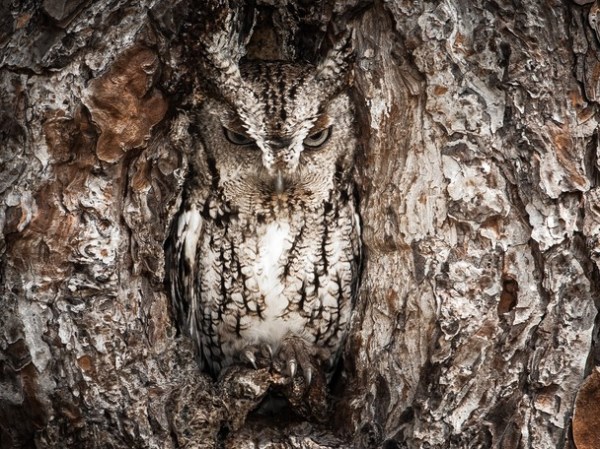
Screech owl. Props.

ScreechOwl

(via)