A pod of false killer whales (Pseudorca crassidens)—a rare species related more to dolphins than true killer whales, or orcas—swim off the coast of New Zealand on April 13.
False killer whales swim in the open ocean and often socialize with bottlenose dolphins. Orcas, however, are not so friendly. They have been seen attacking their false counterparts.
Well, okay, it is partly that. But what it really is is an existential issue. And that distinction is very important.
So, in honor of the impending human achievement of carbon at 400PPM in the atmosphere, here is how we should be thinking about climate change. Because if we don’t understand the problem we can’t divine the solution.
Scripps Institution of Oceanography A curve shows the rising concentration of the greenhouse gas carbon dioxide in the atmosphere. PPM stands for parts per million of CO2 in air. Before the 1800s, the concentration did not exceed 280 parts per million for hundreds of thousands of years.
For hundreds of thousands of years preceding the industrial revolution, the concentration of the greenhouse gas carbon dioxide in the atmosphere didn’t exceed 280 parts per million. Now it is poised to pass 400 parts per million, thanks to the burst of fossil fuel combustion and forest clearing that’s accompanied humanity’s recent growth spurt.
That shift was noticed thanks to decades of work by Charles David Keeling of the Scripps Institution of Oceanography and more recently his son Ralph. (Keeling’s work establishing a meticulous record of CO2 levels at the Mauna Loa Observatory in Hawaii was beautifully described in a 2010 feature by Justin Gillis.)
The question isn’t crazy. The fact that Sir Martin Rees can legitimately ask the question is crazy. Cleverness isn’t wisdom, and that difference has consequences.
The humpback whale that washed up dead on an East Quogue beach last week was well known to scientists and the whale community as a fertile mother tracked since 1976, researchers said this week.
Istar, named after Ishtar, an ancient Babylonian fertility goddess, mothered at least 11 calves, including two in consecutive years, 1988 and 1989, something previously undocumented, said Jooke Robbins, senior scientist at the Provincetown Center for Coastal Studies on Cape Cod in Massachusetts.
“I won’t lie, it’s not really easy,” Robbins said. “Istar is just an individual known for so long, as such a productive whale. She’s a big favorite for so many people.”
Istar was at least 41 years old, measured at 48 feet long and was estimated to weigh 30 to 35 tons, researchers said.
While her cause of death is still under investigation, the whale had massive cranial damage consistent with a ship strike, said Kimberly Durham, rescue program director of the Riverhead Foundation, which performed the necropsy.
I wonder what was on that ship. How important was it? How slow would ships have to go in the whale corridors to reduce the lethality of ship strikes? What would that cost?
The idea of a culture or traditions—behavior shared by an identifiable group and acquired through social learning—in cetaceans, a group including whales and dolphins, has been controversial.
That behavior, called lobtail feeding, was first recorded in one whale in the Gulf of Maine in 1980. Since then, 278 humpback whales—out of about 700 observed individuals that frequent theStellwagen Bank (map) area—have employed the strategy, according to the study, published this week in the journal Science.
What’s surprising to me is not that humpbacks learn from each other. What’s surprising is that we continue to be surprised at all the complex thinking and learning non-human animals do. It’s a reflection of how strong our bias in favor of human exceptionalism is.
One interesting point is that lobtail feeding appears to be a form of adaptation to changes in prey availability:
Lobtail feeding is a variation on a technique called bubble-net feeding, which is used by humpbacks around the world.
In bubble-net feeding, a whale blows bubbles into a kind of net surrounding the prey, corralling them into dense schools. Then the whale lunges up through the school with its jaws wide open, scooping up mouthfuls of food. (Watch a video that shows humpbacks bubble-net feeding.)
In lobtail feeding, the humpback slaps the surface of the water one to four times with the underside of its tail before diving down and blowing the bubble net. Rendell speculates the slaps may keep its sand lance prey from jumping out of the water, away from the whale.
“The origin of this behavior was strongly associated with the collapse of herring stocks and a boom in sand lance stock,” said Rendell. So he and his team suggest that lobtail feeding came about when humpbacks switched from hunting herring to catching sand lances, a type of fish.
So it’s a good thing that humpbacks are smart enough to adapt their hunting strategies and learn from one another. Because humans will continue to impact the oceans and prey they depend on.
This humpback is no doubt glad we are so impressed, but probably wishes he would be left alone to dine in peace:
“I was standing by the shore, pulled by the deepest blue.”
This week’s selection comes from Amy Mayers, who says:
I need to be near water. When I need a short break and some healing, I turn on “Hipsters” by Deacon Blue. It never fails to give me an internal “ahhhhhhhhhhhhhhh” (exhale and relaxing 🙂 ). It also reminds me to keep daring!
(Who’s going to hook us all up for next week? Send me your Earthist Music selection at timzimmdc@gmail.com)
Have a great weekend.
The Hipsters
All, all those waves
And that old sun
Shining
So drive
Drive to the coast
And let the water
Surround you
I was standing by the shore
Pulled by the deepest blue
Aching for the allure
Of the hipster boys
And the hipster girls
Shining
Friends, who needs friends?
When there’s a road
And an ocean
I was standing by the shore
Pulled by the deepest blue
Aching for the allure
Of the hipster boys
And the hipster girls
Shining
When I let the dream
Die slowly down
Did I do it right
Or was I wrong?
I was standing by the shore
Pulled by the deepest blue
Aching for the allure
Of the hipster boys
And the hipster girls
Shining, falling
Glistening, diving…..
There were two aspects I have been meaning to follow up on, which further illustrate the complexities and subtleties of killer whale entertainment.
As I noted in the previous post, Taku’s little stunt was written off as “baby behavior.” Calves are naturally immature, inexperienced, and can be unpredictable. According to Carol Ray, another former SeaWorld Florida trainer from that era, Katerina and Taima were also well known for that sort of acting up as calves. Former SeaWorld Florida trainer Samantha Berg adds: “Taima had her way with Teri Corbett’s ponytail on more than one occasion, until management decided that women working Taima in the water had to wear their hair in a bun. But I don’t know how long that rule lasted.”
So when calves went off script it was tolerated–up to a point.
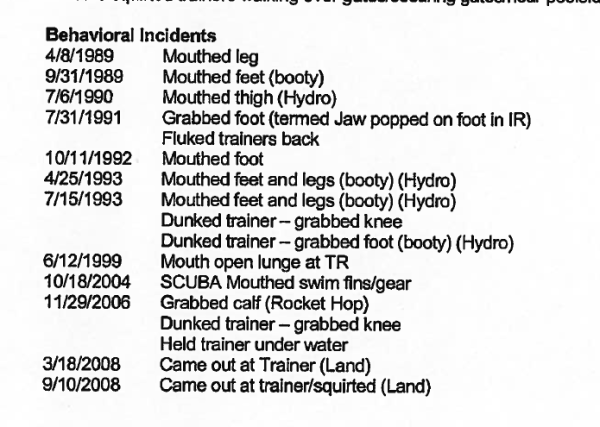
But the fact that calves are unpredictable and sometimes do not do what they are supposed to do created an interesting dilemma for SeaWorld regarding waterwork. On the one hand, a number of SeaWorld killer whale mothers have been sensitive to whether their caves were with them in the pool. The most notorious is Kasatka at SeaWorld California, whose profile notes that aggression was sometimes linked to “when she was separated from her calf and her calf was in distress.” Kasatka’s profile includes a pretty long rap sheet of incidents, a number of which were attributed to a calf being in another pool and/or vocalizing.


 The Earthist Chronicles