Self-Inflicted Pandemic?

Some say the world will end in fire, some say in ice. I say it might just be a raging epidemic arising from the virulent combination of modern farming practices, dense populations, and global culture.

Is the H7N9 scare a harbinger of how it will go? Foreign Policy ponders:

At this writing, 108 cases of H7N9 flu, as the new virus has been dubbed, have been confirmed, and one asymptomatic carrier of the virus has been identified. Twenty-two of the cases have proven fatal, and nine people have been cured of the new flu. The remainder are still hospitalized, many in severe condition suffering multiple organ failures. As the flu czar of the World Health Organization (WHO), Dr. Keiji Fukuda, terselyput it to reporters last week, “Anything can happen. We just don’t know.”

On this tenth anniversary of China’s April 2003 admission that the SARS virus had spread across that country — under cloak of official secrecy, spawning a pandemic of a previously unknown, often lethal disease — Beijing finds itself once again in a terrible position via-a-vis the microbial and geopolitical worlds.  In both the SARS and current H7N9 influenza cases, China watched the microbe’s historic path unfold during a period of enormous political change. And the politics got in the way of appropriate threat assessment.

Well worth the full read.

Orcas vs. Sperm Whales (Take 3): Underwater Video

Shawn Heinrichs has posted a great video about the encounter, and his excursion beneath the surface. Ballsy, and worth it.

About the video:

15 miles off the coast of Sri Lanka, a pod of Orcas trap a family of Sperm Whales. The action intensifies as the Orcas slam into the Sperm Whales, working as a unit to try and separate an individual and take down their prey.

Our story takes place on an epic expedition to Sri Lanka where our team spent 9 days at sea in search of Blue Whales. Accompanying me was my expedition partner Paul Hilton, my brother Brett, and close friends Douglas Seifert, Phil Sokol and Michael Umbscheiden. Together we battled rough seas, burning sun, cramped boat conditions and long days searching endless seas. Though not so successful with Blue Whales, what we did achieve was beyond anything any of us could have imagined, as we documented a world first underwater! This is our story!

OSHA vs. SeaWorld: Hearing Update

Screen Shot 2013-04-25 at 3.12.36 PM

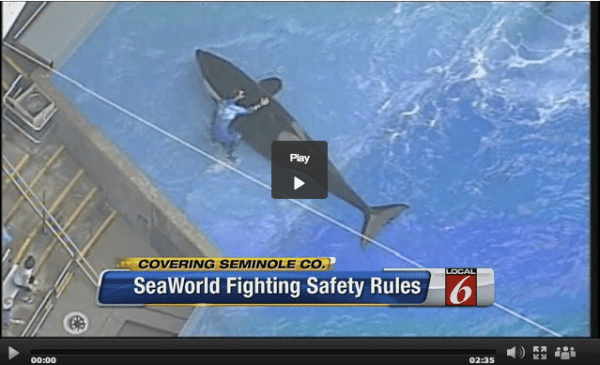
Local 6 was in the courtroom, and Local 6 has a report on how the day went:

In court Thursday, SeaWorld lawyers said the company consulted with marine mammal experts from the Georgia Aquarium and Atlantis Resorts in the Bahamas to establish its own minimum distances trainers can interact with killer whales. Neither facility houses killer whales.

According to SeaWorld Animal Training Curator Kelly Flaherty Clark, trainers are now required to stay three feet away from killer whales if they are kneeling on a flat surface. Trainers must be 18 inches from the edge of the pool if they standing near the whales, she said.

Clark testified that trainers may still touch a killer whale or rub its back while standing next to the animal on a submerged ledge in the pool, as long as the trainer is positioned along the side of the animal’s body between its blowhole and tail. The trainer must stay away from the whale’s mouth and tail and have an escape route if the whale were to move, said Clark.

Under cross examination by OSHA lawyers, Clark acknowleged a killer whale can potentially spin 360 degrees on the submerged ledge as a trainer stands next to it. OSHA lawyers point out that it is up to the employees themselves to determine whether the whale might attempt to hurt them.

“Everything we did was about making sure my employees were safe,” testified Clark, who said no SeaWorld trainers have been injured since Dawn Brancheau was drowned by a killer whale in 2010. “We haven’t even had a scraped knee.”

Judge Welsch must know more about SeaWorld and killer whales than he ever dreamed possible. Following the hearing he will rule on whether SeaWorld had a good excuse for missing last July’s deadline to be in compliance with his ruling that trainers must maintain a minimum separation or work from behind a barrier.

I don’t think he will care as much about whether SeaWorld has suffered any scraped knees, as he will about the question of whether SeaWorld had any legal justification to ignore his ruling and avoid compliance. Some judges might take that hard.

SeaWorld Vs OSHA (Round 412)

They are in court again right now, debating trainer-killer whale protocols, and an Orlando reporter is live-tweeting the proceedings.

Screen Shot 2013-04-25 at 12.07.00 PM

Moment Of Zen:

Horseshoe Bend, Glen Canyon, Arizona, U.S. (Credit: poorpoor/Flickr)

Trainer Corner: John Hargrove On “Drywork” Risk

As SeaWorld and OSHA continue their backroom and courtroom dealings over what sort of interactions SeaWorld trainers should be allowed to have with SeaWorld’s killer whales, the question of the risks inherent in drywork is central.

“Drywork” is when trainers interact with the killer whales on slideouts, stages, and shallow ledges. That is in contrast to waterwork, which is interactions in which trainers are in the pools with the killer whales. SeaWorld stopped performing waterwork after Dawn Brancheau was killed by Tilikum (even though Brancheau was in fact doing drywork according to SeaWorld’s definition). Given the OSHA citations and court rulings so far, it doesn’t seem likely that SeaWorld will feature waterwork again anytime soon.

However, SeaWorld, it appears, would like to work out a deal that would modify OSHA’s stipulation that trainers maintain a minimum distance or work from behind a barrier, and allow SeaWorld trainers during shows to have close contact with killer whales when the trainer (and often the killer whale, too) is out of the water on the stage or a slideout.

I think that we can stipulate that a trainer in the water with a killer whale is much more vulnerable than a trainer out of the water. But even if that is so, OSHA’s main concern has to be what sort of risks to trainers exist during drywork. OSHA’s expert witness when it faced off against SeaWorld in court in 2011, Dr. David Duffus (who also features in Blackfish) has long been of the view that a killer whale’s speed, power and intelligence means that the risks to trainers are inversely correlated to the distance that exists between a trainer and a killer whale. No distance = higher risk. Greater distance = lower risk.
Screen Shot 2013-04-17 at 5.12.27 PM

As OSHA ponders how much risk there is in trainers getting close to killer whales, I thought I would ask an expert, John Hargrove, a former SeaWorld senior trainer with long experience at both the SeaWorld California and SeaWorld Texas parks.

Hargrove told me that the risk for trainers who are out of the water “is low.” But he also made clear that risks remain, and “that we have documented past incidents which prove trainers can be struck.”

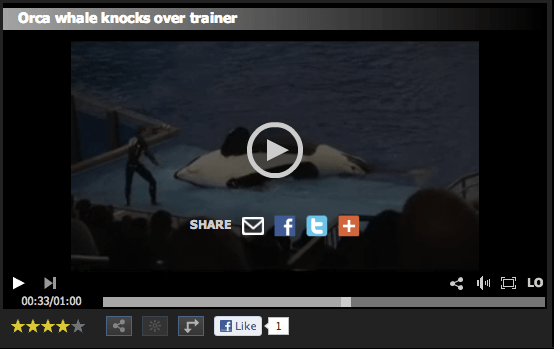
He cited as an example an incident at SeaWorld California in which Orkid broke off a requested behavior underwater and instead came up on the stage and struck a trainer, sending her tumbling, and putting her in the hospital. “Orkid intentionally slid out and struck her,” Hargrove says, noting that any time a whale is sliding across the stage–which is a popular behavior–it has the opportunity to strike trainers. “The only safe place to be during a stage slide is far stage right or left, in a place where there is no set blocking the trainer from jumping back. Anywhere else the whale can crush you if they want to.”

Another time, during a sonogram, Orkid came up out of the water and struck that same trainer as she stood poolside, knocking her over a wall. Continue reading “Trainer Corner: John Hargrove On “Drywork” Risk”

Death By Killer Whale

Transients hunting and eating harbor seals. They are calm, calculating, and brutally efficient:

Moment(s) Of Zen: Earth

Courtesy of NASA, the best space-based views of Earth captured in the past year. 

Worth appreciating, and protecting. And some sacrifice.

Guns vs. Butter

Or maybe Guns vs. Clean Tech R&D, since this a veganized blog. Either way, I am pretty sure we could have put $4 trillion to a better use:

What About The Male Chicks?

Last year, while I was pondering making the leap from vegetarian to vegan, I talked to some PETA friends about eggs and dairy. I asked them what was wrong with milk from well-treated cows, going through the natural cycle of calving, or eggs from chickens that lived natural lives.

“What about the male calves who can’t grow up to be milked?” they replied. “What about the male chicks who can’t grow up to lay eggs?”

The answer is that they are slaughtered. Now, I believe that the humane farmers don’t slaughter the male offspring in the same hideous way that factory farms take care of business. But that answer was enough to convince me that it is very hard to eat any animal products, no matter how well the animals are treated, with a good conscience.

And this morning I recalled that conversation when I cam across this video depicting the fate of male chicks at America’s largest egg-laying facility. It does not show some random workers abusing animals. It shows an industrialized process that is a horrific dramatization of how egg-laying and egg-eating has no place for male chicks (or beaks).

The extent to which the industrial food industry has institutionalized mass slaughter through the use of technology is truly shocking, and a pretty good reminder of why the industry does everything it can to keep the processes it uses to put cheap food on plates hidden from the people happily eating that food.

Here’s Mercy For Animals’ explanation of what is going on:

For the nearly 150,000 male chicks who hatch every 24 hours at this Hy-Line facility, their lives begin and end the same day. Grabbed by their fragile wings by workers known as “sexers,” who separate males from females, these young animals are callously thrown into chutes and hauled away to their deaths. They are destined to die on day one because they cannot produce eggs and do not grow large or fast enough to be raised profitably for meat. Their lives are cut short when they are dropped into a grinding machine – tossed around by a spinning auger before being torn to pieces by a high-pressure macerator.

Over 30 million male chicks meet their fate this way each year at this facility.

For the surviving females, this is the beginning of a life of cruelty and confinement at the hands of the egg industry. Before even leaving the hatchery they will be snapped by their heads into a spinning debeaker – a portion of their sensitive beaks removed by a laser. Workers toss and rummage through them before they are placed 100 per crowded box and shipped across the country.

The callous disregard for animal welfare at this facility is not isolated. In fact, the conditions documented during this investigation are completely standard and acceptable within the commercial egg industry. Referred to by Hy-Line corporate leaders as mere “genetic products,” these chicks are treated just as they are viewed – as inanimate objects, rather than the sentient creatures they are.

Those numbers are pretty staggering. One way Mercy For Animals would like to address the issue is by placing a label on all those egg cartons depicting idyllic chicken life:

Eating habits would change quite a bit if there was absolute honesty and transparency regarding how food is produced. Let’s add that label suggestion to my suggested tuna label.