Wetass Weekly Marketing Initiative #1

Okay, so I’ve created this fun (at least it’s fun for me) newsletter, called Wetass Weekly. It’s an e-mail that subscribers receive once a week, filled with links to the best stories and videos about adventure and the outdoors. And it costs just $1.99 a month, less than a cup of half-decent coffee.

I set a low price because I wanted the charge to subscribers to be negligible, and I also wanted to be sure subscribers feel like it is a good deal (I figure if every subscriber sees one or two items every week that inspires or impresses them, then that is worth the 50 cents they just put in my pocket). But that means I need to scare up subscribers, and that means I confront a classic writers problem. I have content (lots of it, and good stuff, too), but what I really need is marketing.

Plenty of writers are good at marketing themselves. Me, not so much. But part of the fun of starting anything new is the challenge of learning new things. So I am trying to get creative about marketing. And I figured I might as well clear out my closet as I go. So I have launched the first in a series of marketing giveaways. And this week’s Wetass Weekly incentive is a rare, and very red, Audi MedCup cap (snagged at last year’s MedCup Marseilles event).

The MedCup is the Formula 1 of professional sailboat racing. Here’s what the Audi MedCup TP52 action looks like:

And here it is in moving pictures:

And if you are the 15th person to subscribe to Wetass Weekly using this link, then I will send you the above hat. And maybe when you wear it sailors will think that you are either a) such an amazing sailor that you are a MedCup regular; b) so successful that you run a $2 million a year MedCup team; or 3) you won it in an off-the-wall marketing campaign started by some blogger.

Whatever, it is a nice hat. So go for it. Subscribe. You might win. Even if you don’t, you will get a weekly guide to some of the best content online. For just pennies. As Charlie Sheen would say, that’s “Winning!”

An American In Paris, I Mean The Mini Transat

(Originally published on SailingWorld.com)

The Mini Transat is hands-down one of the most testing, exhilarating, intense sailboat races any sailor can choose from the long list of epic sailing challenges. Solo, 4,200 miles across the Atlantic from France to Brazil, in a Spartan, designed-to-the-edge-of-safety, 21-foot boat that’s a brutal bitch to drive to weather but an absolute rocket off the wind. Being solo and masochistic, the race is of course dominated by the French. But it’s always refreshing to see Americans take a crack at the Mini Transat, and in 2003 Jonathan McKee almost upset the established order of the universe by threatening to win—before the sailing gods woke up and flicked his mast over the side as he zeroed in on the finish. What’s even more unusual is when an American woman sails up to the start line, and this year’s distaff daredevil is one Emma Creighton, from San Francisco.

www.emmacreighton.net

If Creighton makes it to the start, and then—just as importantly—makes it to the finish, she’d be the second American woman ever to complete the Mini Transat. The first was Annapolis’ own Gale Browning, who finished the race in 2001. Plenty of Annapolis sailors remember the sight of Gale sailing her tiny boat on the Chesapeake every chance she got, as she prepared for her Atlantic crossing. Despite the fact that the usual 4 knots of Chesapeake “breeze” was not ideal preparation for slamming to weather across the Bay of Biscay or surfing through the tradewinds at double-digit speeds, Gale managed the not insignificant feat of finishing, and even managed to beat another boat across the line—whereupon she promptly put her boat up for sale. “It was the toughest challenge I ever took on,” she says. “And it’s really hard whether you’re a man or a woman.”


http://www.galebrowning.com

Creighton still needs to complete her 1,000-mile qualifier, in Pocket Rocket, her 2006 Prototype Mini, and says she plans to set off this week. After sailing the double-handed division of the Pac Cup last summer, and a bunch of short-handed San Francisco Bay races, she shipped the boat to France and has lined up a series of Mini races to sharpen her skills and familiarity with the boat. She completed her first real solo race earlier this month, the 300-mile Pornichet Select, and discovered something pretty important. “I hadn’t realized just how much I would enjoy racing alone,” she says.

The Pornichet was fairly light, and Creighton will no doubt face a sterner test when she heads off on her qualifier, which will take her around the Fastnet Rock. But she’s plugging along with her plans, hoping to pull it all off and sail to Brazil. Succeeding would give her some serious cred, which she thinks will help her make her way aboard some big-boat ocean-racing teams. “It’s hard for everyone to break in on that scene, but especially hard for women in the U.S.,” she says. “I also hope to get back into the Melges 32 at some point. And the Tour de France a la Voile is very cool.”

The top sailors in the Mini class spend years honing their skills, pour lots of sponsorship money into their Mini Transat campaigns, and spend tons of time on the water. Creighton is still feeling her way into the Mini, and there are still a lot of unknowns for her. “The first leg [to Madeira] is a little scary,” she says. “And I don’t know how I will deal with being alone for three weeks.” Accordingly, she’s keeping her goals modest: “I just want to finish,” she says, but later goes on to admit that she would also love to break into the top 20 in the Proto class. That’s ambitious, but the Mini Transat is about dreaming big.

Introducing Wetass Weekly

Kätzchen
Image via Wikipedia

Every month, I read tons of of stuff about adventure and the outdoors. I watch lots of videos. And as a result I see a lot of pretty amazing content. But I also see plenty of terrible, eye-gouging, stuff. Not exactly cats-playing-with-a-ball-of-wool-type stuff, but plenty of material that is definitely a waste of time.

The good stuff I recommend in a sort of random way to my friends, and on Twitter. But I recently came across an interesting online service that makes it very easy to create and manage a newsletter. It’s called Letterly, and I want to use it to send out a weekly newsletter that will try to capture the best of the best in online content from the worlds of adventure and the outdoors.

The Wetass Weekly will aim to be a quick weekly guide to a small selection of great articles and videos about adventure, extreme sport, or the environment–content that will be well worth your time, and be laid out in a way that lets you click right to it. My goal is to every week send you something that will amaze or inspire you. Or simply make you laugh or slap your forehead in disbelief. And it will cost just $1.99 a month (subscribing is a painless snap, via the wonders of Amazon).

Ice climbing
Image via Wikipedia

I’ve just created the inaugural Wetass Weekly, to give it a try, and it includes links to–among other recommendations–the best article you will ever read about mankind’s checkered efforts to control the waters of the mighty Mississippi (I know this because the author was placed on this earth to write about exactly this sort of topic), an inside look at danger and death in professional cycling, and a mesmerizing video about the devastating practice of shark finning. Plus, I tell you about the best documentary I’ve seen since Grizzly Man.

You can check it out by subscribing here. And don’t worry, if you don’t find anything I send you each week remotely interesting or worthwhile, unsubscribing just takes one click on the Unsubscribe link at the bottom of every newsletter.

Enhanced by Zemanta

Bicycle Economics

I’ve (half-) joked about bicycling saving the world. But I keep coming across more and more analysis to back up the claim. Elly Blue, over at Grist, has been posting some good stuff on bicycle economics, which help make the case (though I hold no illusions about how far rational argument goes in our completely dysfunctional political culture).

Here’s what she has to say about the cost savings associated with moving from cars to bikes:

Imagine getting a $3,000 to $12,000 tax rebate this year. Now imagine it coming again and again. Every year it grows by around a thousand dollars.

Imagine how this would change your daily life.

Sounds like a teabagger’s wet dream, but it’s actually a conservative estimate of how much you’d save by ditching your car, or even just one of your cars — and getting on a bicycle instead.

Read the whole thing, which has links to some good studies. I’ll leave you to ponder the power of Bike-o-nomics with this graphic (click image for larger version).

Enhanced by Zemanta

Could Climate Change Lead to World War?


Global mean surface temperature difference fro...
Climate bomb? (Image via Wikipedia)

Well, even something short of that would not be good. But over at Grist, climate economist Nicholas Stern explains why the answer is “yes.”


Lord Nicholas Stern, one of the world’s most prominent climate economists, believes that failure to address global warming could eventually lead to World War III. In 2006, he produced the “Stern Review” on behalf of the British government, clearly laying out the potentially catastrophic economic consequences of failing to address climate pollution. Since then, the scientific understanding of the damages from global warming has grown, and Stern has warned that his report “underestimated the risks.” In an exclusive interview with ThinkProgress, Stern described his current understanding of the stark consequences of inaction, which defy the scope of standard economic language. If no global policy to cut carbon pollution is enacted, there is about a 50 percent risk that global temperatures would rise above levels not seen for 30 million years by 2100, an extraordinary rate of change. The “potentially immense” consequences of this radical transformation of our planet, Stern explained, include the “serious risk of global war.”


Enhanced by Zemanta

Solo-Sailing To Save The Taiji Dolphins

(Originally published at SailingWorld.com)

You have to admire California-based solo sailor Michael Reppy, now in his 60s. He wants two things in life: first, to set the singlehanded transpacific record from San Francisco to Tokyo; and second, to help stop the Japanese drive fisheries (made notorious by the film, “The Cove” ) that slaughter thousands of dolphins every year.

Lots of would-be record-setters link (sometime in the most casual of ways) their attempts to environmental causes, but Reppy has been singularly dogged in his efforts to both set the record AND call-out the Japanese on their brutal, annual dolphin drives. He’s about to set on out his fourth attempt on the record—set by Bay Area singlehander Peter Hogg at 34 days, 6 hours—on his 43-foot trimaran, Dolphin Spirit.

Hogg laid down that mark in 1992, besting a time set by the legendary Eric Tabarly in 1969. And Reppy has been trying to better it ever since.

It’s certainly been an exciting campaign. His first attempt, in 1997, in a 36-foot Shuttleworth-designed trimaran, ended in classic solo-sailing multihull fashion, which is to say with a spectacular pitchpole within days of Tokyo and the record. For that attempt, Reppy partnered with Earth Island Institute to draw attention to a pod of killer whales captured by the Taiji drive fishermen.

Thirty days into the journey, as Reppy ripped along at 18 knots through squally weather 300 miles from Tokyo, he was anticipating a big press turnout to mark his imminent record. With a gale forecast, he wanted to make as many miles as he could before dropping his spinnaker. When he finally came on deck after a nap to drop it, he was a few minutes too late. As he stepped into the cockpit, the tri took off on a wave, stuck a bow in, and cartwheeled. Reppy dove back into the cabin and called for rescue. Eighteen months later, his tri turned up on the island of Midway. Bummer.

He made his second and third attempts in 2000 and 2001 in the classic Warren Luhrs Open 60 Thursday’s Child. Ironically, he lost a chunk of rudder to a whale on the first voyage and came up short thanks to light winds on the second. Now, he’s back with the speedy Dolphin Spirit, planning to set off in April. His hope is that, since the success of “The Cove,” the tide of sentiment in Japan is turning against the cruel drive fisheries. He’s again promoting Earth Island, this time their Save Japan Dolphins initiative.

Reppy wants that record. But he also wants the big press conference in Tokyo he was denied when he pitchpoled in 1997. He knows there’s only so much a foreigner can achieve in Japan, but there’s no questioning the sincerity with which he’s doing his part to stop the dolphin slaughter. “Japanese media: that’s the whole ballgame, because for years and years they would not report on it,” he tells me. “There isn’t much of an environmental movement in Japan, and that’s what we’ve been trying to help develop.”

Any sailor who’s seen the beauty and grace of dolphins playing in a bow wave, or marveled at their intelligence and, yes, humanity, has to be rooting for Reppy and the dolphins of Taiji. So I’ll be following this one with more than casual interest. You can too, and also learn a lot more about Reppy and his solo-sailing advocacy at the Dolphin Spirit website. And our friends over at Pressure Drop have also posted a nice video interview:

Reinventing Humanity

I hope the world takes note of Carl Safina, and his new book, The View From Lazy Point (NYT review is here; Mother Jones review here). Safina is an original and deep thinker, and The View From Lazy Point is both an homage to the natural world and a clarion call–that is remarkably gentle yet utterly persuasive–for reimagining how humans live and interact with our humble planet.

I was drawn to Safina’s work because I have long been troubled by the idea that humanity has been intelligent enough to achieve great technological triumphs, yet not wise enough to find harmony and balance in human affairs or our understanding of the finite nature of Earth. We are well past the need to try and arouse humanity from its material, consumptive ways with a deluge of depressing and enervating detail about environmental destruction. That’s been going on for decades, and people have either chosen to recognize reality, or blind themselves.

What’s needed now are pathfinders and prophets who can redefine what it means to be human, and what changes humanity should make to its behaviors, economies, and cultures. Safina is searching for those sorts of answers and that’s why he is worth reading and talking about. I have no doubt that a critical mass will eventually develop behind the need to reinvent humanity. The only question is what sort of planet we will be living on when it happens. I am pessimistic, even nihilistic, about the prospects for a reasonable transition to this new epoch. But all anyone who cares can do is put out a light and hope people are drawn to it. As Safina writes: “Just as we went from hunter-gatherers to agriculturalists to civilized societies, now we must take the next great leap: from merely civilized to humanized.” Or wise. That would be nice.

Dept. Of Biking Can Save The World

Ordinary bicycle, Skoda Museum, Mlada Boleslav...
Image via Wikipedia

I know, I know. It can’t really “save” the world. But it has so much upside it deserves some hype.

This week the National Bike Summit is convening here in DC. And if there is one takeaway it is that biking is a supremely cost-effective investment.

In a town where almost nothing gets decided in a rational manner that focuses on costs and benefits (and instead gets hijacked by ideology, special interest money and cable madness), it’s always important to hammer away at this point. And the League Of American Bicyclists is doing exactly that, highlighting lots of research on how biking pays off big-time.

Here’s a one-stop sampling of the analysis (with links) that any bike advocate can use to blow away any bike-haters that get in his or her face:

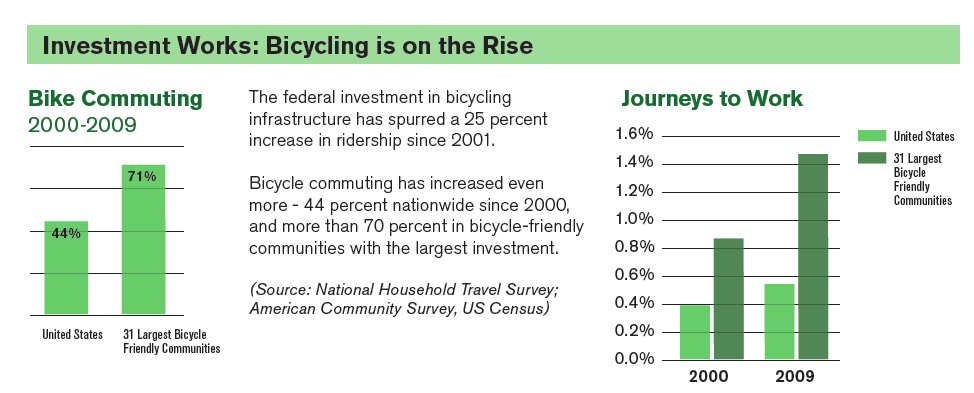
In 2009, we released a literature review of the best research into the economic impacts of investing in bicycling infrastructure. Since then there have been several good additions.

Let’s review:

Between 1995 and 2010, the Portland region spent $4.2 billion on roadway improvements and $153 million on all active
transportation improvements.
Since 1990, the City of Portland saw an increase of 14,912 in daily bicycle commute trips and 37,006 in daily auto trips.
The cost of a new auto trip in Portland was approximately 22 times the cost of a new bicycle commute trip

Cost-effective: Between 1995 and 2010, the Portland region spent $4.2 billion on roadway improvements and $153 million on all active transportation improvements. Since 1990, the City of Portland saw an increase of 14,912 in daily bicycle commute trips and 37,006 in daily auto trips. The cost of a new auto trip in Portland was approximately 22 times the cost of a new bicycle commute trip.

Another new Portland study, by Thomas Gotschi, found that:

By 2040, investments in the range of $138 to $605 million will result in health care cost savings of $388 to $594 million, fuel savings of $143 to $218 million, and savings in value of statistical lives of $7 to $12 billion. The benefit-cost ratios for health care and fuel savings are between 3.8 and 1.2 to 1, and an order of magnitude larger when value of statistical lives is used.

Job creating: A Baltimore study shows that for each $1 million spent, striping bike lanes and signing bike routes creates twice as many jobs as repaving and repairing roads, thank to a favorable labor to materials ratio.

Economy supporting: Bicycle tourism brings in a $1 billion to the Wisconsin economy, in addition to the $556 million from manufacturing, distribution, and retail.

…and then there’s the Green Dividends of…

New York City

Chicago

San Diego

and Portland.

So dig in and go wild. And keep on riding.

Here’s Rep. Earl Blumenauer, founder of the Congressional Bike Caucus, doing his bit:
Vodpod videos no longer available.


Not to encourage you to become a bike bore, but here are 5 slides to get you started (from the National Bike Summit program).

The Allure Of The Antarctic

The Antarctic is remote, relatively unspoiled, and infinitely intriguing. In case you doubt it, here is a spectacular collection of photographs from the Antarctic, compiled by the always stunning In Focus feature, over at The Atlantic. Make sure you take a few minutes to browse the full gallery of 47 shots, but here are a few of my favorites:


The aurora australis provides a dramatic backdrop to a Scott Tent at Amundsen-Scott South Pole Station on July 14, 2009. (National Science Foundation/Patrick Cullis)
A leopard seal captures a Gentoo penguin near Palmer Station, Antarctica on April 4th, 2009. (National Science Foundation/Sean Bonnette)
A 20-minute exposure reveals the southern celestial axis above the new elevated station at Amundsen-Scott South Pole Station on July 21, 2009. At the poles, scientists can study a fixed point in the sky for months and years, whereas in the middle latitutes the stars 'move' across the night sky. The white cloudy streak is the Milky Way. (National Science Foundation/Patrick Cullis)
Gentoo penguins squabble in their colony in Antarctica on November 24th, 2010. Photographed as part of a fundraiser/trip titled the Penguin Project. (pinguino k / CC BY)
Heavy equipment operators work to clear snow and smooth the annual sea ice near McMurdo Station, creating a landing strip in this photo taken September 24, 2009. The first C-17 jet of the austral summer landed on this runway with passengers and cargo on September 29, kicking off another season of scientific research for the US Antarctic Program. (National Science Foundation/Lori Gravelle)
Raised footprints in the Antarctic snow. After a storm, the loose snow surrounding the compacted snow under a footprint is scoured away by the wind, leaving an elevated strange-looking footprints. Original here. (Alan R. Light / CC BY)
In this photo taken on Feb. 9, 2011 and released by Sea Shepherd Conservation Society, Japanese whaling factory ship Nisshin Maru approaches Sea Shepherd's high-speed trimaran Gojira while using water cannons during their encounter in Southern Ocean, Antarctica. Japan has temporarily suspended its annual Antarctic whaling after repeated harassment by the conservationist group, a government official said Wednesday, Feb. 16, 2011. (AP Photo/Sea Shepherd, Simon Ager)
A Weddell Sea finds a human-made hole in the annual sea ice a convenient opportunity to catch her breath on November 7, 2009. (National Science Foundation/Robyn Waserman)


Enhanced by Zemanta

Arctic Ice Extent At Record Low In January

It felt pretty cold down here at latitude 37 degrees, which gave the climate deniers on Capitol Hill plenty of grist for superficial cracks about global warming. But perhaps they should take a look at the top of the world, where January saw the lowest ever recorded extent of Arctic sea ice.

From NASA:

This image shows the average Arctic sea ice concentration for January 2011, based on observations from the Advanced Microwave Scanning Radiometer for EOS (AMSR-E) aboard NASA’s Aqua satellite. Blue indicates open water; white indicates high sea ice concentrations; and turquoise indicates loosely packed sea ice. The yellow line shows the average sea ice extent for January from 1979 through 2000.

NSIDC reported that ice extent was unusually low in Hudson Bay, Hudson Strait, and Davis Strait in the early winter. Normally frozen over by late November, these areas did not completely freeze until mid-January 2011. The Labrador Sea was also unusually ice-free.

The shrinking of the polar ice cap is a fascinating story, with untold implications for species, the environment, and human culture and economies. I’m hoping to do some reporting on it very soon.

Enhanced by Zemanta