Insight Of The Day

To continue the exploration of humanity’s relationship with animals, on a gloomy, rainy day here in Washington, DC, Matthew Scully, author of the powerful Dominion (a must-read), looks at humanity’s moral obligations to “our companions in creation.” It is excerpted from this interesting and provocative essay urging conservatives to extend the same moral calculus they apply to late-term abortion to the question of industrial farming and meat consumption:

Far from presenting any threat to human dignity, animals and their moral claims upon us — the basic obligation never to be cruel, not just the option to be kind when it suits our purposes — are a constant hindrance to human presumption. What is the mark of that special status of ours, anyway, if not precisely the ability to be just instead of merely dominant, to be the creature of conscience and bring mercy into the world? A loving concern for humanity that stops there, instead of spreading outward in a sense of fellowship and active respect toward “our companions in creation,” to borrow a lovely phrase from Pope Benedict, is too close to self-worship, and bad things come of it.

Animals are always getting in the way of prideful and willful people, who act as if all things exist for their pleasure and expect everything to yield to their designs and appetites, no matter how base or disordered. In that way, a dutiful regard for animal welfare helps keep us humble, as a natural check against all of mankind’s own endless fiats, much as the duty to put the interests of children first can steer adults and entire societies away from all kinds of destructive self-indulgence. No group bears a heavier duty of self-restraint toward other creatures than the people who farm them, and John Paul II, in a 2000 address, had a message specifically for modern agriculture: “Resist the temptations of productivity and profit that work to the detriment of nature. When you forget this principle, becoming tyrants and not custodians of the Earth, sooner or later the Earth rebels.”


Fracking Up The Water

It’s still astounding to me that we are rushing headlong into widespread fracking without truly understanding what its environmental implications are. It’s a classic example of our inverted approach to technology in which a technology is accepted until someone proves it is dangerous, instead of having the wisdom to hold off on a technology until it is (reasonably) demonstrated that it is safe.

Anyhow, this sort of finding illustrates why this inverted approach is perhaps unwise:

In the state of Pennsylvania, home to the lucrative Marcellus Shale formation, 74 facilities treat wastewater from the process of hydraulic fracturing (a.k.a. “fracking”) for natural gas and release it into streams. There’s no national set of standards that guides this treatment process—the EPA notes that the Clean Water Act’s guidelines were developed before fracking even existed, and that many of the processing plants “are not properly equipped to treat this type of wastewater”—and scientists have conducted relatively little assessment of the wastewater to ensure it’s safe after being treated.

Recently, a group of Duke University scientists decided to do some testing. They contacted the owners of one treatment plant, the Josephine Brine Treatment Facility on Blacklick Creek in Indiana County, Pennsylvania, but, “when we tried to work with them, it was very difficult getting ahold of the right person,” says Avner Vengosh, an Earth scientist from Duke. “Eventually, we just went and tested water right from a public area downstream.”

Their analyses, made on water and sediment samples collected repeatedly over the course of two years, were even more concerning than we’d feared. As published today in the journal Environmental Science and Technology, they found elevated concentrations of the element radium, a highly radioactive substance. The concentrations within sediments in particular were roughly 200 times higher than background levels. In addition,  amounts of chloride and bromide in the water were two to ten times greater than normal.

This may or may not turn out to be clear proof of how misguided our assessment of fracking turns out to be. But it is clear proof that we should do more to assess fracking’s full implications before pumping fracking fluid into every underground formation that contains the slightest whiff of shale oil.

A Cow Going To Slaughter

There’s no blood, no gore. Just a cow coming to grips with its fate, as an industrial process it can’t even begin to comprehend nudges it forward. But it does comprehend the one key fact about that process: something terrible is about to happen.

That foreknowledge, and the reaction, is at the heart of humanity’s consumption of meat. It is repeated millions of times every year (and often in much more stressful, gruesome circumstances). It is worth keeping in mind when anyone starts talking about “humane slaughter,” because this moment is part of every slaughter. And it is very hard to watch or justify. (via)

“Dogs Are People, Too”

Yet another powerful data point that buttresses the idea that the more we study animal cognition and intelligence the smarter and more emotionally complex we understand animals to be. Rarely, if ever, does a study of animal intelligence conclude: “Well, they are dumber than we thought.”

FOR the past two years, my colleagues and I have been training dogs to go in an M.R.I. scanner — completely awake and unrestrained. Our goal has been to determine how dogs’ brains work and, even more important, what they think of us humans.

Now, after training and scanning a dozen dogs, my one inescapable conclusion is this: dogs are people, too…

…The ability to experience positive emotions, like love and attachment, would mean that dogs have a level of sentience comparable to that of a human child. And this ability suggests a rethinking of how we treat dogs.

DOGS have long been considered property. Though the Animal Welfare Act of 1966 and state laws raised the bar for the treatment of animals, they solidified the view that animals are things — objects that can be disposed of as long as reasonable care is taken to minimize their suffering.

But now, by using the M.R.I. to push away the limitations of behaviorism, we can no longer hide from the evidence. Dogs, and probably many other animals (especially our closest primate relatives), seem to have emotions just like us. And this means we must reconsider their treatment as property.

This leads nicely into a logical (and powerful) argument about the need for some sort of limited legal personhood for dogs and other animals.

I’m not sure why research is necessary to prove that dogs and other animals have emotions, as well as think and feel in ways that we humans can understand and recognize. Perhaps humanity jealously guards its sense of exceptionalism (not to mention the desire to exploit animals freely for profit). But if this is the sort of research that is required to get humanity to rethink the ways in which we subordinate and treat animals, then I am glad it is being done.

Sylvia Earle On The Oceans

Speaking of the future of the planet’s watery realms, here’s an excellent podcast of Sylvia Earle talking about humanity and its impact:

If you’re inspired by Earle’s ability to pull this off at age 78, just wait: The real inspiration lies in her stunning plea for ocean conservation. In this episode of Inquiring Minds (click below to stream audio), Earle doesn’t shy away from giving us the really, really big picture. She explains that we’re the first generation of humans to even know what we’re doing to 96 percent of the Earth’s water—through assaults ranging from over-fishing to noise pollution to global warming’s evil twin, ocean acidification.

Older generations just didn’t get it; they simply had no idea they could have this effect. “We have been under the illusion for most of our history, thinking that the ocean is too big to fail,” Earle says. Now, thanks in large part to the work of ocean adventurer-scientists like Earle, we know better. And we’re right at that crucial moment where knowing something might actually help us make a difference.

Actually, I think knowing something about 50 years ago might have really helped us make a difference. We often don’t want to know until we are on the edge of disaster, and that is naturally very late in the game. Still…

How Acidic Are The Oceans?

It’s one of the key questions of the global warming puzzle, and the X Foundation is stepping in to incentivize the scientific world to invent a good way to monitor ocean pH:

Scientists know this is killing coral reefs and dissolving the shells of marine animals, but the overall danger of ocean acidification is still poorly understood. To fix that, the X Prize Foundation announced a new bounty this week: $2 million for anyone who can figure out how to figure out what all this extra CO2 is doing to the pH of our planet’s oceans.
Named the Wendy Schmidt Ocean Health X Prize, the 22-month competition is scheduled to kick off in early 2014 and name its winner(s) in 2015. The $2 million jackpot is divided into two purses, which can be won separately or by the same team. The X Prize Foundation provides this description of the potential winnings on its website:
  • Accuracy award ($750,000 first place, $250,000 second place): To the teams that navigate the entire competition to produce the most accurate, stable and precise pH sensors under a variety of tests.
  • Affordability award ($750,000 first place, $250,000 second place): To the teams that produce the least expensive, easy-to-use, accurate, stable and precise pH sensors under a variety of tests.
This is the latest of many such trophies from the X Prize Foundation, which launched in the 1990s with a $10 million contest aimed at spurring commercial space travel. (It was inspired by the Orteig Prize, a $25,000 jackpot won by aviator Charles Lindbergh when he flew across the Atlantic Ocean in 1927.) The original X Prize went to aerospace firm Scaled Composites in 2004, whose technology is now part of Virgin Galactic’s SpaceShip Two.
One the one hand, this is the sort of out-of-the-box technology strategy that could help the planet confront warming. On the other hand, it is sort of depressing that we have made the oceans about 30 percent acidic over the past 250 years without really bothering to understand what the implications might be. Humanity has never been skeptical enough about the potential impacts and unintended consequences of technology.

The Story Of Solutions

The “Story Of” series tries to step up with some new ideas. I’m sympathetic but just not sure they go far enough. The ideas are good, just not big enough to change the world.

Personally, I think the single most powerful change (regular readers know where I am about to go) would be to price everything we buy differently. Instead of just pricing the cost of production (labor and materials), every good should be priced according to its production cost AND its social and environmental costs. Imagine how quickly everyone would change their behavior–the impact on consumption and the impact on carbon-heavy goods–and how quickly businesses would change what the create and sell, and how they do it.

Chicken Engineering

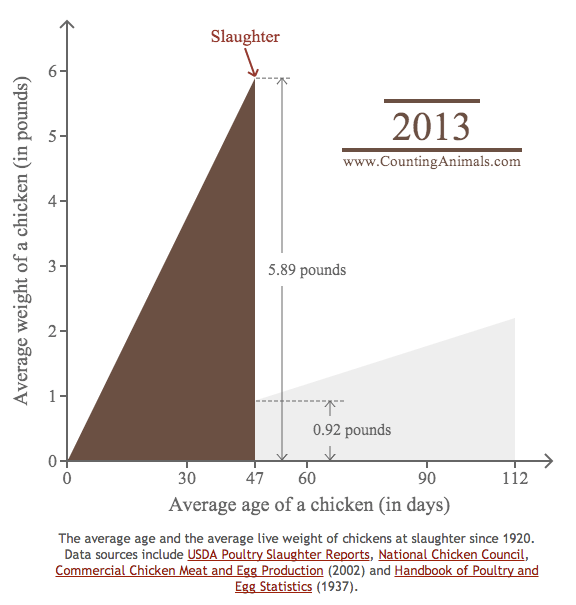
Here’s an eye-opening look at how breeding, hormones and who knows what else has dramatically accelerated the rate at which chickens grow (allowing them to be slaughtered much sooner):

In 1920, a chicken raised for meat was slaughtered at the age of about 112 days (less than 4 months) when he weighed about 2.2 pounds.

Since then, factory farming of chickens has continued a gradual but inexorable rise. With each new decade, chickens were fattened up faster and slaughtered earlier with little regard to the suffering of the chickens.

By 1950, a chicken was fattened up to weigh an average of over 3 pounds in just 70 days, the average age at which he would be slaughtered for his meat.

By 2000, the average chicken raised for his meat grew to weigh over 5 pounds by the time he was slaughtered at the age of 47 days.

Today, in 2013, we fatten them up even faster to weigh 5.89 pounds in just 47 days. Then, we slaughter them.

Even in 1920, chickens used for their meat were likely fattened up as fast as allowed by the know-how at the time. The natural weight of a chicken at 112 days of age, therefore, is no more than 2.2 pounds.

According to the Handbook of Poultry and Egg Statistics, published in 1937, the growth of a chicken during those times was approximately linear. This means that a 47-day old chicken in 1920 weighed approximately 2.2 × 47 ÷ 112 ≈ 0.923 pounds.

According to the USDA Poultry Slaughter reports, the average weight at slaughter in the first seven months of 2013 (January to July) was 5.89 pounds. Slaughtered at 47 days of age, these modern chickens weigh 5.89 ÷ 0.923 ≈ 6.38 times their 1920 counterparts.

Click on the graphic below to see an animated version:

Screen Shot 2013-10-08 at 2.05.38 PM

(via)


Mosquitos And Captive Animals

It’s not just killer whales in captivity who are vulnerable to mosquito-borne diseases. Seems that zoos are having a hard time preventing penguins from being killed by malaria:

Zoos all around the world love penguins. They’re cute, they don’t require much space, they never eat zookeepers. And children adore watching them, especially at feeding time.

But as carefree as they might look, torpedoing through the water or rocketing into the air like a Poseidon missile, zoo penguins are stalked by an unrelenting killer: malaria.

“It’s probably the top cause of mortality for penguins exposed outdoors,” said Dr. Allison N. Wack, a veterinarian at the Maryland Zoo in Baltimore, which is building a new exhibit that will double its flock to a hundred birds. If left untreated, the disease would probably kill at least half the birds it infected, though outbreaks vary widely in intensity.

The avian version is not a threat to humans because mosquitoes carrying malaria and the parasites are species-specific; mosquitoes that bite birds or reptiles tend not to bite mammals, said Dr. Paul P. Calle, chief veterinarian for the Wildlife Conservation Society, which runs New York City’s zoos. And avian malaria is caused by strains of the Plasmodium parasite that do not infect humans.

But for penguins in captivity, the threat is so great that many zoos dose their birds in summer with pills for malaria, said Dr. Richard Feachem, director of global health at the University of California, San Francisco.

Most of the penguin exhibits I have seen (the Central Park Zoo penguin exhibit comes to mind) are crowded, dirty, and sad. Maybe we’ll feel differently about keeping penguins in zoos if the avian malaria virus mutates into a strain that infects humans.

A Global Whale Stranding Network?

This is a great Indiegogo idea to harness smartphone technology with the need to respond as fast as possible to whale and dolphin strandings:

We are looking to create a worldwide network for sightings of beached and stranded whales and dolphins. Developing the app for it however, is the most expensive part of the project. We are therefore appealing to all IT experts to step forward and volunteer their design services. If we can achieve donated help with this aspect of our project then our costs will drop significantly. Funds can then be used instead, towards a public awareness campaign.

This will be helpful for strandings that might otherwise go unreported (such as in countries where there is no stranding network in place), and also it will save researchers valuable time by having the data available in one place.

Candace Calloway Whiting, one of the creators of the project, explains further how a smartphone enabled network could help save whales and dolphins, particularly in an era of intensifying seismic exploration for undersea energy:

Although a half a world apart – one in the Philippines, the other in the British Isles – these stranding events have some things in common.

In both situations an usual variety of normally deep water species were involved, and both involved animals that looked battered and behaved unusually. (Please see “Panicked Whales Are Stranding in Area of Seismic Exploration” for information on the Great Britain strandings).

Both occurred in areas of intense exploration for oil. While the North Atlantic region has a longer history of offshore exploration, some areas of the South China Sea are just opening up. The Philippines is poised to exploit anticipated offshore sources of oil and gas, and is in a hurry to do so – the region is plagued with power shortages and has financial incentives to encourage foreign oil companies to perform seismic surveys of the seabeds.

Go to Indiegogo to learn more about the project and the different perks you can earn via a donation.