I can never quite decide whether this blog should be on WordPress or Tumblr.
So as an experiment I’m, also giving Tumblr a shot (have to say, it’s SO easy to post, which means more posts go up; plus you can embed almost any video).
If you prefer WordPress, no worries, I’ll keep posting new content here and you will find it below this Program Announcement. But if you’d like to try out a different reader experience, check me out at http://timzimmermann.tumblr.com/. You can also follow via RSS Feed, if that’s your thing (that’s the way I roll with the blogs I follow; I loves me some Google Reader).
As part of this social media makeover, I have also started a Tim Zimmermann, Writer Facebook page, so I can rant all I want without alienating (or boring) close friends and family. Check it out, and “Like” it if you like.
The Tumblr site is a bit of a work in progress, but it will get better each and every week. And it should have comments soon.
So hope you will like the new sites, and is you do please follow ’em, tweet ’em, like ’em, and help me spread the word.
I’ve got some big plans that I need you to be part of. So stay tuned. I hope it will be a fun ride.
I know, I know. It can’t really “save” the world. But it has so much upside it deserves some hype.
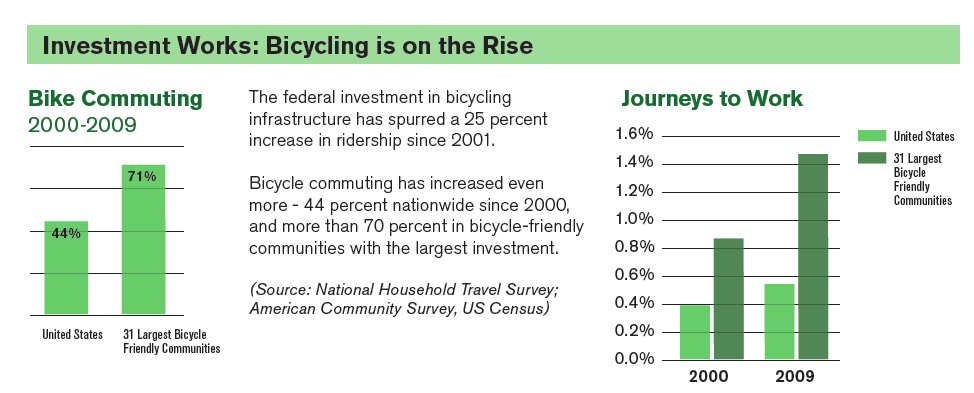
This week the National Bike Summit is convening here in DC. And if there is one takeaway it is that biking is a supremely cost-effective investment.
In a town where almost nothing gets decided in a rational manner that focuses on costs and benefits (and instead gets hijacked by ideology, special interest money and cable madness), it’s always important to hammer away at this point. And the League Of American Bicyclists is doing exactly that, highlighting lots of research on how biking pays off big-time.
Here’s a one-stop sampling of the analysis (with links) that any bike advocate can use to blow away any bike-haters that get in his or her face:
Between 1995 and 2010, the Portland region spent $4.2 billion on roadway improvements and $153 million on all active
transportation improvements.
Since 1990, the City of Portland saw an increase of 14,912 in daily bicycle commute trips and 37,006 in daily auto trips.
The cost of a new auto trip in Portland was approximately 22 times the cost of a new bicycle commute trip
Cost-effective: Between 1995 and 2010, the Portland region spent $4.2 billion on roadway improvements and $153 million on all active transportation improvements. Since 1990, the City of Portland saw an increase of 14,912 in daily bicycle commute trips and 37,006 in daily auto trips. The cost of a new auto trip in Portland was approximately 22 times the cost of a new bicycle commute trip.
By 2040, investments in the range of $138 to $605 million will result in health care cost savings of $388 to $594 million, fuel savings of $143 to $218 million, and savings in value of statistical lives of $7 to $12 billion. The benefit-cost ratios for health care and fuel savings are between 3.8 and 1.2 to 1, and an order of magnitude larger when value of statistical lives is used.
Job creating: A Baltimore study shows that for each $1 million spent, striping bike lanes and signing bike routes creates twice as many jobs as repaving and repairing roads, thank to a favorable labor to materials ratio.
I’ve been waiting for someone to promote a city concept built around bicycles not cars, and someone (actually a group of someones) has got it going on. It’s called, amazingly enough, Bicycle City.
Founder and co-developer Joe Mellett hopes to begin construction “this summer or fall” on homes situated on the 160-acre tract of land that he and his fellow investors purchased for nearly $1 million. The company has the option to purchase an additional 600 adjacent acres.
“There are other industries—solar, wind, what have you—that address the individual components of climate change, but Bicycle City puts it all together into one home,” says Mellett.
Bicycle City’s homes, which will be up to 1,600 square feet, will be constructed according to one of two eco-friendly building guidelines—the U.S. Green Building Council’s LEED certifications or One Planet Living’s 10 principles. Lot price tags will range between $25,000 and $35,000, with individual homes clocking in just north of $100,000. Plans for “bicycle taxis” are also in the works.
“The beauty of that is that if you want to live next to your car, you buy a lot on the perimeter of the community and you’d be within under a minute’s walk to your car,” says Mellett.
Judging from the fact that the lest news was posted in 2008, it seems that the world is not flocking to reserve housing, so maybe we are talking about more of an outpost than a city. But every idea has to start somewhere. And personally, I think the better way to get where Mellett is going is for bikers to try and take over an existing city that is amenable to getting beyond cars, like perhaps Portland, Oregon.
Image by K_Gradinger via Flickr
Anyhow, here’s how (and why) you head in that direction. First bike lanes, then the streets! (Yes, I love to feed the conspiracy wingnuts)…
Hate to say it, but after two-and-a-half years of trying to keep up with this website, I am burned out, cooked, done, finito. Well, not really, but I just don’t have the time anymore to do this thing properly, and I’d rather not just mail it in. Plus, it’s time to head in a new direction and develop other novel means of wasting time while amusing myself. Thanks to all the loyal readers and tipsters. There are plenty of other blogs out there now bringing you the latest in extreme adventure and video, so keep on clicking. It was fun while it lasted. Have a nice life… “Ahh. Time to go surfing…”
There are big swells throughout the Pacific, so let’s fly out there courtesy of Surfline and check them out. First up, a report from the Monster Energy Pipeline Pro. Next, let’s take a look at Waimea, with this nice video. And, finally, we’ve got to get back to rough riding Mavericks, where the big wave competition last week was hot and heavy. Click here to dive into a wicked day. Got to love the internet… Pipe Bomb: KERBLAAAM…!




![Reblog this post [with Zemanta]](https://i0.wp.com/img.zemanta.com/reblog_e.png)


 The Earthist Chronicles